

Our Stories
Welcome to a realm of limitless pawrenting possibilities. Each journey with your furry friend is as exhilarating as the destination. Every shared moment provides a chance to leave your unique paw print on the canvas of existence. You can craft stories filled with joy, laughter, and love. The only limit in this adventure is the extent of your imagination.
From the blog


Latest Posts
Welcome to a world of Pawrenting, where the thrills of shared experiences ignite joy and laughter. The journey is filled with adventures, as exhilarating as the destination, with each day bringing new opportunities for exploration. Start with early morning walks in the park. Then enjoy cozy afternoons spent cuddling on the couch. Every moment is a chance to connect with your furball. You can make memories that could last for a lifetime! As you navigate the ups and downs of pet parenthood, you’ll discover the unique bond that forms through play. Training and quiet times together further strengthen this bond. These experiences create a tapestry of unforgettable moments. They enrich both your lives.
-
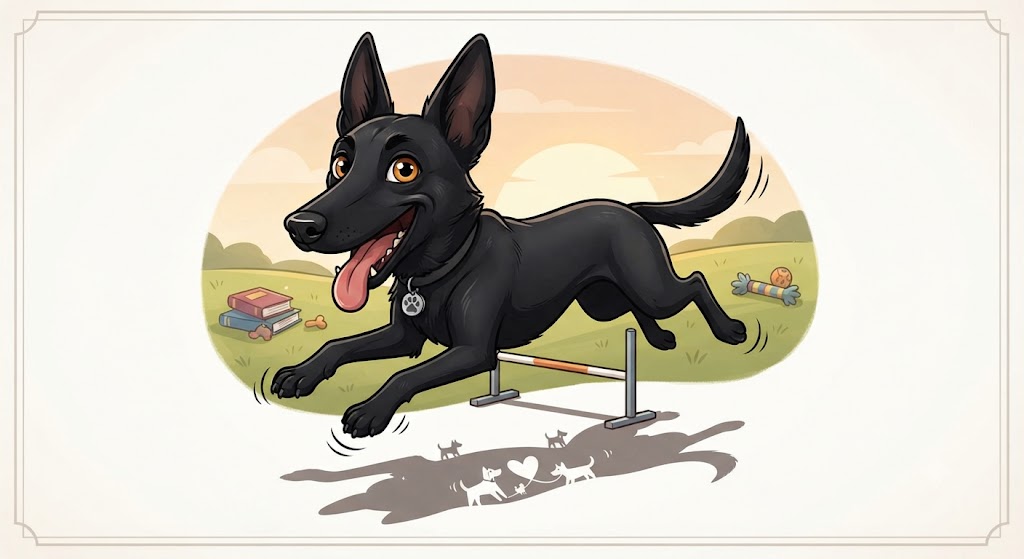
The Belgian Malinois is already a breed defined by superlatives: the fastest, the most agile, the most intense, the most driven. Within the working dog community, they are legendary. Yet, there is a specific, somewhat elusive variant that captures the imagination of those lucky enough to encounter one: the Black Belgian Malinois. Often a result of specific genetics or sometimes misunderstood as a crossbreed, these striking dogs are more than just a deviation in color. They represent the distilled essence of the Malinois spirit, wrapped in an aesthetic that is nothing short of breathtaking. To understand what makes the Black Belgian Malinois so special, we must look beyond the coat and into the depth of their genetics, temperament, and the unique place they hold in the hearts of their handlers.The Genetic Allure
The standard Malinois is famously characterized by its fawn-to-mahogany coat with a black “mask” and black ears. The black coat is, in fact, a genetic variation of the standard breed. While some enthusiasts might debate the purity or the adherence to strict show standards, for the working dog aficionado, the black coat adds a layer of mystery. Because they are not the “classic” look, they stand out in a crowd. They carry a sleek, almost predatory elegance. When a Black Malinois moves—whether it’s a high-speed sprint across a field or a focused, deliberate heel—they appear almost like shadows in motion. This visual distinction is, for many, the initial hook. It breaks the monotony of the standard look and creates a dog that feels singular, almost mythic.A Mirror of the Malinois Soul
However, the color is merely the wrapper. What truly makes these dogs special is that they remain, at their core, pure Belgian Malinois. They possess that hallmark “high drive” that the breed is famous for. If you are looking for a couch potato, you will not find it here. The Black Malinois is an athlete that never truly sleeps. They are perpetually scanning, perpetually working, and perpetually ready to engage. This is a dog that lives for the “job,” whether that job is protecting their family, competing in high-level obedience, or simply mastering the next complex trick.
The special quality of the Black Malinois lies in their intensity. Many handlers report that these dogs seem to have an even more acute “on/off” switch. Because they are so striking, they are often placed in homes or programs where their handler is deeply committed to their training, which in turn brings out a level of brilliance that might be overlooked in a more “common” looking dog. They are sponges for information. They analyze their environment with a startling level of intelligence, learning not just what you want them to do, but why you want them to do it.The “Shadow” Connection
There is a poetic element to the Black Malinois that cannot be ignored. In many cultures, black animals are seen as guardians or protectors. For the owner of a Black Malinois, this feels acutely true. When you walk a dog that looks like a sleek, dark silhouette, there is a natural aura of authority. They are natural protectors who don’t need to bark to command respect. Their presence alone is enough to deter threats.
But this protection comes with a profound sensitivity. Like all Malinois, they are incredibly “handler-soft,” meaning they are hyper-attuned to the emotional state of their owner. A Black Malinois is a mirror. If you are anxious, they are alert. If you are confident and calm, they are the steady partner you’ve always wanted. This bond goes deeper than the average pet-owner dynamic. It is a partnership of two beings who are constantly communicating through micro-adjustments in body language, tone of voice, and intent.The Misunderstood Brilliance
One of the most special things about the Black Malinois is the community that grows around them. Because they are a “rare” variant, owners are often part of a tight-knit, informed group. They spend time discussing the nuances of the breed, sharing tips on training, and laughing about the unique challenges of living with a dog that is essentially a high-performance sports car in a suburban neighborhood.
They are also a constant subject of curiosity. Walking a Black Malinois in public is a never-ending conversation. “What kind of dog is that?” “Is it a mix?” “Is it a wolf?” These interactions provide a perfect platform for owners to advocate for the breed. They get to explain that no, it’s not a mix; it’s a pure, powerful Belgian Malinois. They get to educate others on the importance of training, enrichment, and the specific needs of working breeds. In this way, every Black Malinois acts as an ambassador, challenging the public’s perception of what a dog can be.Why They Are Ultimately So Special
At the end of the day, a Black Belgian Malinois is special because they demand your best. You cannot coast with this dog. You cannot be a passive owner. They force you to be present, to be active, and to be engaged. They teach you that the best things in life are earned—the trust, the obedience, the quiet moments of companionship—they are all products of the work you put in.
They are the “Black Sheep” in the best possible way. They are the beautiful anomaly that reminds us that nature loves to surprise us. Whether they are tearing across an agility course or curled up at your feet after a long day of “work,” the Black Belgian Malinois serves as a daily reminder of the beauty of drive, the power of connection, and the sheer joy of living life in motion. If you are privileged enough to have one, you know: you aren’t just owning a dog. You are sharing your life with a shadow that has a heart of gold.
-
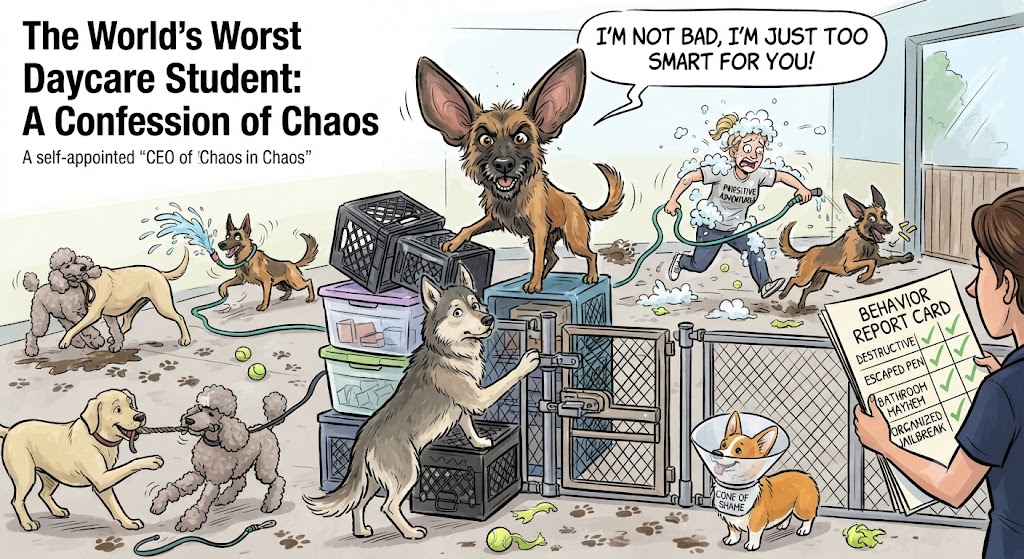
To the uninitiated, the term “daycare” conjures images of serene grassy patches, golden retrievers playing gentle games of tag, and well-behaved pups napping in sunbeams. It is a place of socialization, a sanctuary for the weary pet owner who just needs six hours of productivity. But for those of us who have lived with a high-drive Belgian Malinois—specifically, a rescue Malinois with ears like satellite dishes and a brain that operates at the speed of a fiber-optic cable—daycare is not a sanctuary. It is an Olympic event in damage control. It is an exercise in profound humility. And, quite frankly, my dog Sauli is the world’s worst daycare student.
Let’s be clear: “bad” is a subjective term. In the context of a child, “bad” might mean talking out of turn. In the context of a Belgian Malinois, “bad” means successfully dismantling the structural integrity of a reinforced pen while simultaneously teaching the resident Labradors how to pick locks.
When I first dropped Sauli off at “Pawsitive Adventures,” I had delusions of grandeur. I pictured her learning boundaries, becoming a polite citizen of the doggy world, and perhaps making a few friends. I expected her to run, fetch, and be blissfully exhausted by 5:00 PM. Instead, by 9:00 AM, I received that text message every pet owner dreads—a message that begins with “So, regarding Sauli…” and ends with “please come pick her up.”
Sauli does not “play” with other dogs in the traditional sense. She manages them. She treats the daycare floor like a corporate boardroom where she is the CEO of Chaos, and everyone else is merely an intern she needs to whip into shape. If a dog is running too fast, she intercepts. If a dog is playing too softly, she initiates a “correction.” She is not aggressive, mind you; she is simply an overzealous taskmaster. She is the student who reminds the teacher to assign homework, only the homework is a high-speed chase that leaves the rest of the class panting and confused.
But it wasn’t just her social maneuvering that earned her the title of “World’s Worst.” It was her absolute refusal to accept that rules apply to her. A fence, in Sauli’s eyes, is not a barrier; it is a suggestion. A gate is merely a puzzle waiting to be solved. Daycare staff often pride themselves on their containment strategies—double-gate systems, heavy-duty latches, reinforced fencing. Sauli views these as personal insults.
I remember one specific day when the daycare team decided to graduate her to the “advanced” playgroup, thinking she just needed more stimulation. Within twenty minutes, she had coordinated a mass jailbreak. She didn’t just climb the fence; she found a structural weakness in the corner, boosted a compliant Wolfdog friend up like she was in a heist movie, and managed to open the latch from the outside. By the time the staff realized what was happening, Sauli was sitting in the front office, looking through the glass at the receptionist, her ears pricked, waiting for a treat. She wasn’t running away; she was just bored of the limitations of the yard.
Then there is the bathhouse disaster. Grooming days at daycare are supposed to be luxurious spa moments for dogs. For Sauli, they are tactical warfare. She hates baths with the fervor of a religious zealot. The moment a hose touches her coat, she transforms from a sleek, elegant Malinois into a frantic, splashing octopus. She has, on more than one occasion, managed to escape the tub, cover the entire room in soap suds, and successfully soak every staff member on duty, all while maintaining a look of absolute, righteous indignation. Once, after being locked in a crate to “calm down” after a bath, she decided that whining was not enough. She began a vocal protest that resonated through the building, a high-pitched Malinois shriek that sounded less like a dog and more like a banshee. Within minutes, she had recruited the entire kennel to join in. A chorus of thirty dogs, all howling in solidarity with Sauli, eventually forced the staff to concede.
Yet, as much as she disrupts the peace, there is something undeniably brilliant about her incompetence as a student. She is “the worst” because she is too smart for the system. She is a working breed in a world designed for leisure, a professional athlete trapped in a classroom. She isn’t trying to be “bad”; she is trying to be busy. Her mind is a brilliant, looping program that needs constant input, and a daycare that simply provides tennis balls and a yard will never, ever suffice.
Looking back at her “report cards”—which are mostly just lists of damages and polite requests to explore “alternative training methods”—I have realized that Sauli doesn’t need a daycare; she needs a job. And in a way, she has one. Her job is to keep me on my toes, to remind me that life is never static, and to ensure that I never get too comfortable with the idea of a quiet afternoon.
Being the human to the world’s worst daycare student is exhausting, yes. It is humbling, certainly. But it is also a masterclass in living with a force of nature. She may have been kicked out of every playgroup in the city, but she has taught me more about resilience, creativity, and the sheer joy of testing boundaries than any obedient dog ever could. She isn’t failing daycare; she’s just teaching it a lesson it wasn’t prepared to learn. And honestly? I wouldn’t have it any other way.
-
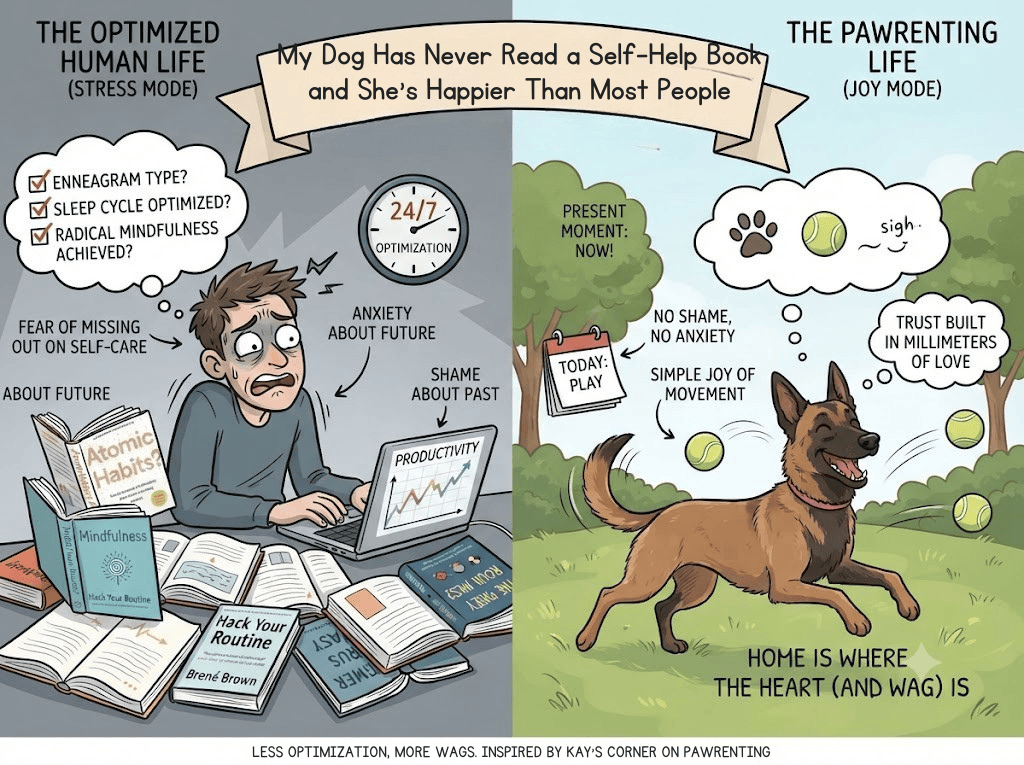
My nightstand is a quiet graveyard of good intentions. It is stacked with the heavy hitters of modern self-improvement: books on habit-stacking, guides to radical mindfulness, and manifestos on how to “hack” your morning routine for peak productivity. Each volume promises a version of me that is more optimized, more peaceful, and somehow more “arrived.” Yet, as I sit there highlighting passages on how to be present, I often find myself looking down at Sauli, my Belgian Malinois rescue, who is currently attempting to fit three tennis balls in her mouth simultaneously.
Sauli has never read a single page of Brené Brown. She doesn’t know her enneagram type, she hasn’t optimized her sleep cycles, and she certainly doesn’t practice “intentional breathing.” And yet, she possesses a grounded, vibrant contentment that I—with all my folders of notes and podcast bookmarks—frequently struggle to touch.
The Tyranny of the Optimized Life
We live in a culture obsessed with fixing the human condition. We treat our lives like software that needs constant patching. We are told that if we just find the right strategy, the right morning ritual, or the right mindset shift, we will finally unlock the door to happiness. This pursuit, while noble in its intent, often creates a secondary layer of anxiety: the fear that we aren’t doing “self-care” correctly.
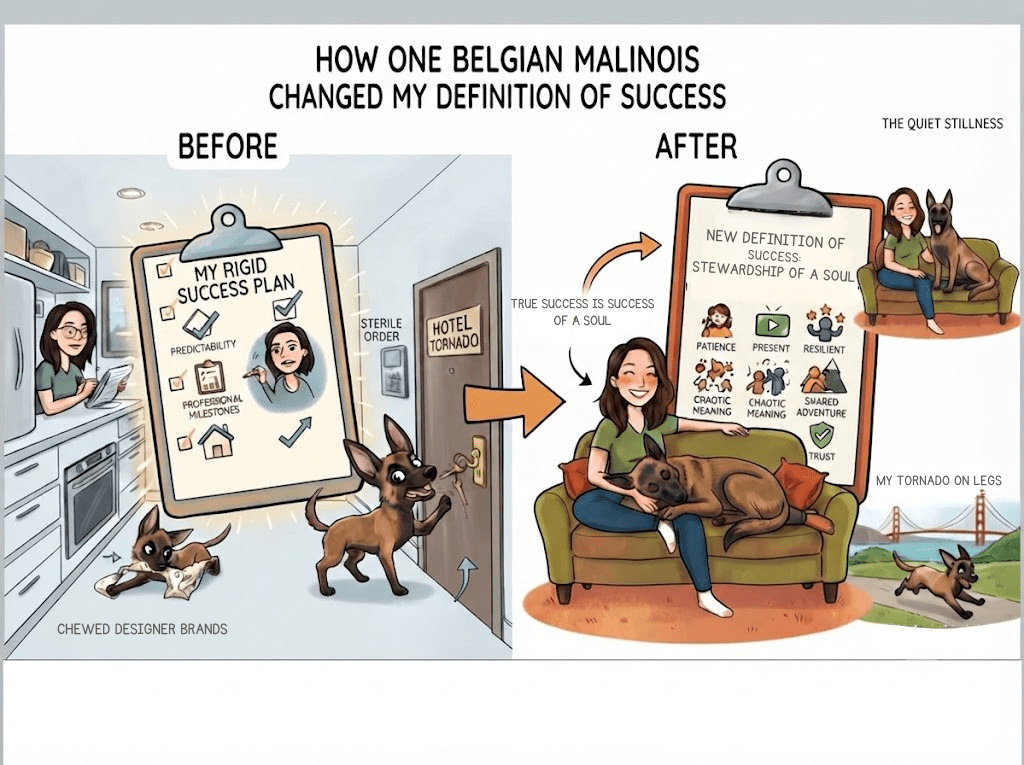
Then there is the Belgian Malinois. Sauli is a high-drive, high-energy “tornado on four legs”. When we first met in Wisconsin, she didn’t wait for a formal introduction to show me who she was. She was a whirlwind of shredded pillows and escape attempts. In those early days, particularly during the infamous “Hotel Tornado” weekend, I tried to apply my human logic to her chaos. I wanted her to be “calm.” I wanted a “curated” bonding experience.
But Sauli taught me that life isn’t something to be curated; it’s something to be lived. She didn’t need a 5-step guide to trust me; she just needed a consistent bowl of kibble and the realization that we had survived the storm together.
The Master of the “Now”
The cornerstone of almost every self-help book is the directive to “be here now.” We spend billions of dollars on apps and retreats to learn how to inhabit the present moment. For Sauli, the present isn’t a destination she works toward; it’s the only place she lives.
When Sauli chases a ball in a San Francisco park, she isn’t thinking about the “Great Escape” she attempted in Wisconsin or the time she got fired from daycare. She isn’t worrying about whether she’ll be a “good dog” tomorrow. There is no shame about the past and no anxiety about the future. There is only the flight of the ball, the scent of the grass, and the pure, kinetic joy of movement.
Humans are the only species that spend our “now” worrying about our “then.” We carry the weight of yesterday’s mistakes like a heavy pack, and we scan the horizon for tomorrow’s threats. Sauli reminds me that every walk is an adventure if you let it be. To her, a rainy day isn’t a ruined schedule; it’s a new set of smells and a chance to snuggle closer on the couch.
Connection Over Complexity
In our quest for better relationships, we often turn to complex communication strategies and psychological frameworks. We guard our hearts, we wait for the “right time” to be vulnerable, and we measure our loyalty against transactional metrics.
Sauli’s approach to connection is embarrassingly simple. It is built in millimeters of trust, not miles of strategy. When she rests her head on my lap, it isn’t because she has processed her “attachment style”; it’s because she has decided, against her previous experience as a scared rescue, that the world is safe again.
This is the “unexpected wisdom of wet noses”. Dogs don’t fake their emotions. If she is happy, her whole body wiggles; if she is wary, her intelligence sparks in her eyes. There is a profound honesty in that simplicity. She doesn’t need a book to tell her that love is a mutual contract of showing up—not as a savior, but as a partner.
The Mutual Rescue
Ultimately, the contrast between the self-help shelf and the dog on the rug comes down to the source of joy. Self-help often looks inward, focusing on the “I.” Sauli looks outward, focusing on the “Us.”
I thought I was the one doing the rescuing when I clicked “submit” on that adoption form. I thought I was bringing her home to give her a better life. But the truth is more nuanced. Sauli rescued me from my own rigid schedules and my sterile desire for order. She forced me to trade my to-do lists for the rhythm of a wagging tail.
We don’t need more “hacks” for happiness. We need to be more like the Belgian Malinois who thinks rules are suggestions but loyalty is absolute. We need to realize that home isn’t a place we reach through self-optimization; it’s a feeling of belonging that we find when we stop trying to “fix” ourselves long enough to realize we are already chosen.
Sauli may never read a self-help book, but every time she nudges my hand with her cold, wet nose, she teaches me the most important lesson of all: the best way to find yourself is to get lost in the beautiful, chaotic life of another living being.

