
Our Stories
Welcome to a realm of limitless pawrenting possibilities. Each journey with your furry friend is as exhilarating as the destination. Every shared moment provides a chance to leave your unique paw print on the canvas of existence. You can craft stories filled with joy, laughter, and love. The only limit in this adventure is the extent of your imagination.
From the blog
Latest Posts
Welcome to a world of Pawrenting, where the thrills of shared experiences ignite joy and laughter. The journey is filled with adventures, as exhilarating as the destination, with each day bringing new opportunities for exploration. Start with early morning walks in the park. Then enjoy cozy afternoons spent cuddling on the couch. Every moment is a chance to connect with your furball. You can make memories that could last for a lifetime! As you navigate the ups and downs of pet parenthood, you’ll discover the unique bond that forms through play. Training and quiet times together further strengthen this bond. These experiences create a tapestry of unforgettable moments. They enrich both your lives.
-

When I signed up for the journey of dog parenthood, I did so with a head full of romanticized visions. I imagined serene morning walks through dappled sunlight, a devoted companion gazing soulfully at me from across the room, and perhaps an occasional, manageable amount of shedding. I was prepared for the vet visits, the routine vaccinations, and the necessity of keeping the kibble bin stocked. What I was decidedly not prepared for—and what, quite frankly, the books and glossy advertisements consistently omit—was the absolute, unadulterated chaos that defines life with a high-drive dog.
Nobody warns you about the specific, creative ways a bored or misunderstood dog can dismantle your domestic tranquility. They warn you about “chewing,” but they don’t describe the forensic precision with which a puppy can deconstruct a sofa, not because they are “bad,” but because they have discovered that the stuffing inside makes for an excellent confetti cannon. They don’t mention the “Zoomies,” which are less of a cute dog behavior and more of a localized weather event—a Category 5 cyclone that occurs exclusively in your living room at 10:00 PM, involving high-speed collisions with furniture and frantic parkour off your shins.
Then there is the issue of “optional” boundaries. The literature often discusses training in terms of “commands” and “obedience.” It implies a clean, linear progression from “Sit” to “Stay.” In reality, “parenthood” with a dog like my Belgian Malinois is a negotiation. You realize quickly that doors, to her, are merely polite suggestions. I remember the first time I realized she had mastered the art of the handle—not by turning it, but by launching her entire body weight against the door with such ferocity that it simply surrendered. It was a terrifying, yet begrudgingly impressive display of physics and determination.
We aren’t told about the social faux pas. You prepare for the “good boy” compliments, but you don’t prepare for the mortification of being “that person” at the park. There are days when the “Adventures in Dog Parenthood” feel less like a lifestyle choice and more like a high-stakes performance art where you are constantly apologizing for your partner’s inability to understand the concept of personal space. I’ve spent more time than I care to admit explaining that no, she isn’t aggressive, she is just “enthusiastically greeting you by trying to climb your leg.”
The emotional toll is another unspoken dimension. There are days when the exhaustion is so profound you start to question the fundamental premise of your decision. When you are covered in mud, your favorite rug is ruined, and you are currently being stared down by a creature who expects a walk despite the fact that you haven’t slept in four hours, the “pawrenting” dream feels incredibly distant. These are the moments that no one talks about at the dog park. They are the moments of genuine frustration where the bond feels strained by the sheer weight of responsibility.
Yet, it is precisely in these unscripted, unglamorous, and often exasperating moments that the real relationship is built. You stop trying to force your dog into the mold of the “perfect pet” you read about online. You stop measuring your success by how well they follow the training manual and start measuring it by the small, quiet victories. It’s the moment they finally stop pacing and curl up on the floor near you, not because you commanded it, but because they have chosen that spot. It’s the realization that while they may have “fired” themselves from daycare by being too much to handle, they are still your constant, albeit chaotic, shadow.
These “adventures” teach you a brand of humility that you cannot learn elsewhere. You learn to laugh at the absurdity of your life. You learn that a pristine home is a low priority compared to a happy, tired, and mentally stimulated companion. You learn that your definition of success—which once involved perfectly executed to-do lists and clean floors—has been replaced by a new, more elastic definition: Did we both survive today? Did we laugh at the ridiculousness of it all? Is there a wet nose currently nudging my hand?
Ultimately, the adventures nobody warns you about are the ones that actually matter. They are the friction that wears down your ego and polishes your patience. They are the messy, loud, unpredictable incidents that transform you from a human living with a dog into a “pawrent” living with a companion. You don’t sign up for the shredded pillows or the midnight escape attempts, but you end up keeping them. You keep them because, in the middle of all that chaos, you found a version of yourself that is more resilient, more present, and significantly less bothered by a little bit of dirt. And that, I’ve found, is the greatest adventure of all.
-
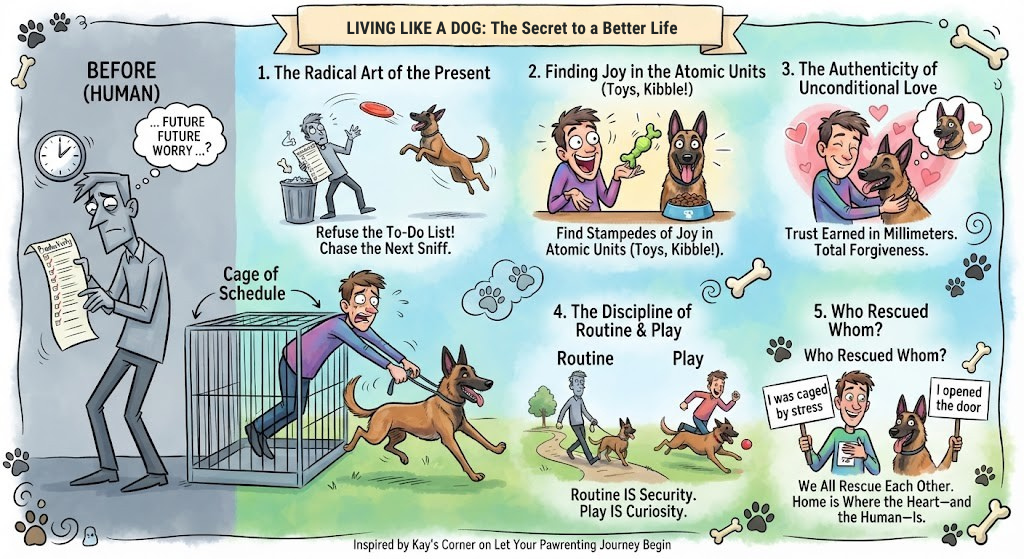
In the frantic velocity of modern existence, humans often find themselves trapped in a “cage” of their own making—a construct of rigid schedules, digital noise, and the perpetual anxiety of what comes next. We are a species obsessed with the future and haunted by the past, rarely inhabiting the narrow, vibrant sliver of time known as the present. Yet, curled up on the rug or waiting by the door, our canine companions offer a silent, wagging masterclass in a different way of being. To look at the journey of a rescue dog like Sauli is to see a transformation that is not just about a dog finding a home, but about a human finding a new rhythm for life.
The Radical Art of the Present
The primary wisdom of dogs lies in their absolute refusal to acknowledge a to-do list. While we navigate our days through the lens of productivity, dogs like Sauli operate through the lens of presence. When Sauli first arrived in Wisconsin, she wasn’t a passive recipient of a “rescue” plan; she was a “Hotel Tornado,” a whirlwind of energy that demanded immediate attention and partnership. She didn’t worry about the long journey to San Francisco or the “Hotel Tornado” aftermath; she focused on the next sniff, the next tug-of-war, and the next moment of connection.
Living like a dog means trading the sterile order of a planned life for the beautiful, chaotic meaning of the “now”. For a dog, every walk is an adventure if you let it be. They remind us that happiness isn’t a destination we reach after checking off our tasks; it is the quality of our attention to the current moment. Whether it is the cool breeze of an ocean trail or the simple joy of a sunny patch on the living room rug, dogs teach us that the present is the only place where life actually happens.
Finding Joy in the Simple and the Small
Humans have a tendency to gatekeep their own happiness, setting complex conditions for when we are allowed to feel content. Dogs, conversely, find profound fulfillment in the atomic units of daily life. A squeaky toy, a fresh bowl of kibble, or the sound of a familiar key in the lock is enough to trigger a “stampede” of joy. This “survival intelligence” allows them to find light even after trauma.
Consider the philosophy of “mindful dog ownership”. It involves noticing the things humans often miss: the nuance of body language, the specific scent of a city after rain, or the quiet power of being chosen. When we adopt the canine perspective, we realize that “home” isn’t a physical address in a city like San Francisco or Mumbai—it is the feeling of belonging and being safe with “someone who waits for you”.
The Authenticity of Unconditional Love
Perhaps the most transformative lesson we can learn from a rescue dog is the nature of trust and forgiveness. Dogs never fake their emotions. Their loyalty is not a given; it is a hard-won treasure earned in millimeters through patience and consistent care. Sauli’s transition from a scared rescue pup to a confident companion required a mutual contract of vulnerability.
Dogs offer a form of “pawrenting” that is built on connection rather than just commands. They reflect back to us our own hidden reservoirs of compassion and our capacity for resilience. Unlike humans, who often let past grievances color future interactions, a dog’s forgiveness is total. Once trust is established—like the moment Sauli finally rested her head on her human’s lap—the bond becomes a “friendship that would weather any storm”.
The Discipline of Routine and Play
While we often view routine as a mundane burden, for a dog, it is the framework of security. The “Adventures of Sauli” are built on the predictable rhythms of walks, playdates, and rest. This balance of discipline and play is essential for a mindful existence. Sauli might think “rules are suggestions,” but she thrives when she has a purpose, whether that’s chasing a red ball in the park or “inspecting” open homes during work.
We often forget that play is not just for children or puppies; it is a vital expression of curiosity and freedom. Curiosity is, in many ways, the opposite of fear. By approaching the world with a “wet nose and a wagging tail,” we replace our defensive postures with an open-hearted engagement with the world.
Who Rescued Whom?
Ultimately, the wisdom of dogs suggests that we are all “rescue stories” in progress. We think we are bringing them into our lives to save them, but they are the ones who open the cages of our rigid schedules and sterile order. They teach us that success isn’t defined by a title or a bank account, but by the depth of our connections and our ability to remain present in the face of chaos.
To live like a dog is to acknowledge that no matter how many walls we have built or how many times we have been “caged” by stress, there is always room for a new chapter. It is the realization that the best way to find yourself is to get lost in the beautiful, chaotic life of another living being. As we watch a dog sleep peacefully, dreaming of the day’s adventures, we are reminded of the ultimate canine truth: Home is where the heart—and the human—is.
-
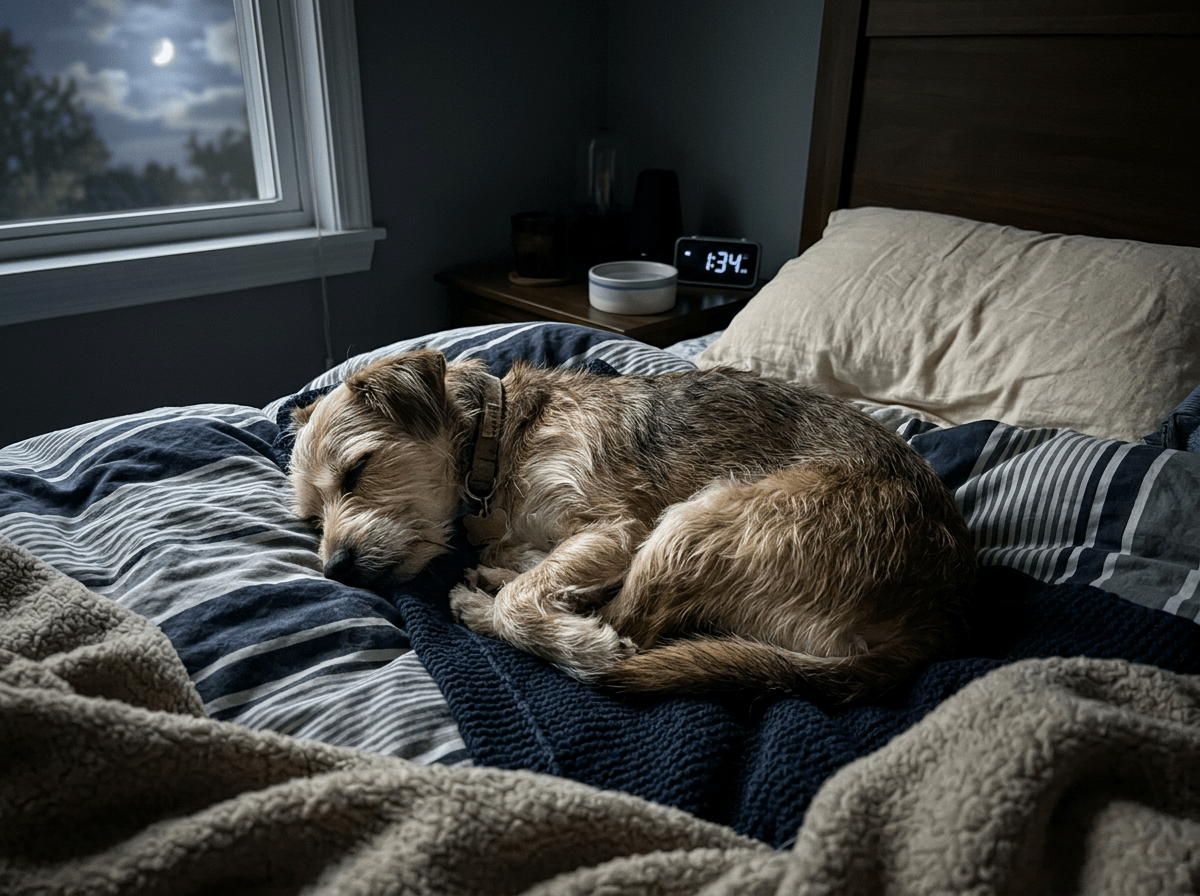
The narrative of animal rescue is frequently curated through a lens of human heroism—a savior reaching into a cold cage to offer a second chance to a creature without a voice. We are conditioned by social media to expect the “Freedom Ride” to conclude with a heartwarming montage of a dog curling up on a plush bed, sighing in relief, and instantly realizing they are home. However, the reality of that first night is often far removed from the cinematic “love at first sight” we are sold. It is messy, exhausting, and filled with a specific brand of anxiety that new “pawrents” rarely discuss openly.
When I first saw Sauli’s picture, I viewed myself through that hero lens, thinking I could simply “save” her. I didn’t realize then that the first night would be less of a quiet bonding experience and more of a “Hotel Tornado”. For many rescue dogs, the first night isn’t about gratitude; it is about survival intelligence and sensory overload.
The Sensory Storm of Disorientation
To a rescue dog, your home does not initially represent safety; it represents a vacuum of the familiar. Every scent—the laundry detergent, the floor cleaner, the lingering aroma of your dinner—is a new data point that must be analyzed for potential threat. On that first night in Wisconsin, Sauli was not a grateful recipient of my care; she was a force of nature. The environment was a whirlwind of shredded pillows and escape attempts through hotel windows.
This disorientation manifests in behaviors that can be deeply discouraging to a new owner. There is the pacing—the rhythmic click-clack of nails on hardwood that continues long into the 3:00 AM hour. There is the panting, a physiological sign of a cortisol spike that no amount of soothing whispers seems to de-escalate. In Sauli’s case, it was a midnight attempt to navigate the lock of a hotel door, her tiny paws scratching at the mechanism in a desperate bid for the familiar outdoors. We often projecting “loyalty” onto dogs, but on night one, loyalty is an unearned luxury. Trust is built in millimeters, and the first night is often spent at kilometer zero.
The Human Toll: The “What Have I Done?” Moment
There is a quiet, shameful thought that often creeps into the minds of new adopters during the first night: I have made a terrible mistake. This occurs when the “Hotel Tornado” is in full swing, and you are staring at a shredded rug or a puddle on the floor while the dog stares at you with wary, intelligent eyes that don’t yet see you as a friend.
The exhaustion is not merely physical; it is emotional. You have prepared for weeks, buying the best kibble and the softest toys, only to realize that the living being in front of you is a “miniature agent of chaos”. During that first weekend, I spent my time alternating between trying to contain the whirlwind and watching in bewildered amusement, wondering if I had bitten off more than I could chew. The first night is the death of the fantasy and the birth of the reality. It is the moment you realize that the “rescue” is a mutual contract: you provide the roof and the name, but they provide the hard-won realization that you are not a savior, but a partner.
The Decompression Period and the 3-3-3 Rule
Professional trainers often refer to the “3-3-3 rule”—three days of decompression, three weeks of learning routines, and three months of feeling truly at home. The first night falls into that initial three-day window where the dog’s brain is essentially in a state of high alert. They are not “being bad” when they destroy a pillow; they are expressing a level of anxiety that has no other outlet.
In the chaos of those early days with Sauli, the dynamic only began to shift when I stopped trying to force a connection and started respecting her space. The first night often requires the human to be a calm, boring anchor rather than an enthusiastic cheerleader. It requires accepting that the dog may not eat, may not sleep, and may spend the entire night huddled behind a couch or testing the strength of their crate.
The Slow Bloom of Trust
Despite the “Hotel Tornado” and the midnight escape attempts, something subtle happens in the quiet hours of that first night. After hours of mischief and pacing, there is often a moment where the adrenaline fades. For Sauli, it was finally resting her head on my lap after a weekend of mischief. It wasn’t because I had “saved” her, but because we had survived the storm of the transition together.
The first night is rarely beautiful, but it is necessary. It is the grit that makes the eventual bond so deep. Because rescue dogs have known loss, their loyalty is not a given; it is a hard-won treasure. When they finally decide, against their previous experience, that your home is safe, the victory is monumental.
Ultimately, we talk about the first night as a hurdle, but it is actually a foundation. It moves us from a life of sterile order to one of beautiful, chaotic meaning. Looking back at the “Hotel Tornado,” I realize that Sauli wasn’t just a scared pup; she was a confident companion waiting to be discovered through the mess. The first night nobody talks about is the one where you stop being a hero and start being a pawrent.

