
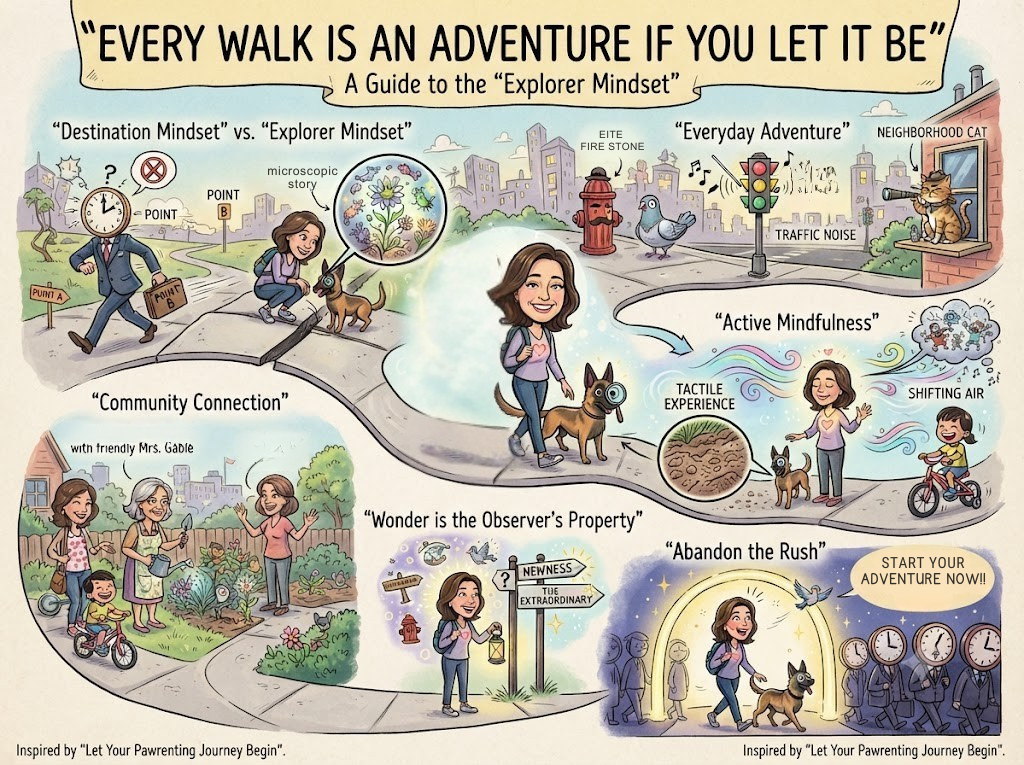
In a world defined by the relentless pursuit of speed and efficiency, our daily routines have become increasingly automated. We move from point A to point B with our eyes fixed on our destinations, our minds preoccupied with the next item on our to-do list, and our senses dulled by the repetitive rhythm of our commute. We treat the act of walking not as an experience in itself, but as a tedious, necessary bridge between where we are and where we need to be. Yet, embedded within this most primal of human activities lies a profound opportunity: the chance to transform the mundane into the extraordinary. Every walk, no matter how familiar the path, becomes an adventure if we choose to let it.
To view a walk as an adventure requires a fundamental shift in perception—a move from the “destination mindset” to the “explorer mindset.” When we step outside, we are essentially entering a living, breathing narrative. Even the most urbanized environment is teeming with subtle changes, ephemeral details, and microscopic stories that vanish the moment we stop paying attention. A walk becomes an adventure the second we allow ourselves to notice the texture of the light filtering through the trees at 8:00 AM versus 8:15 AM. It becomes an exploration when we observe the way the wind alters the sound of the traffic on a busy street corner, or when we catch the scent of rain on dry pavement before the first drop even falls.
The beauty of this perspective is that it requires no exotic location. It does not demand a hike through the Andes or a stroll along the cliffs of Amalfi. The magic of “everyday adventure” is that it is scalable. A walk to the grocery store can be as enlightening as an expedition if we approach it with curiosity. By deliberately slowing our pace, we engage a different part of our cognitive architecture. We stop “processing” our environment and start “perceiving” it. This is where the adventure takes hold. We notice the way a neighborhood cat watches the world from a hidden perch, or the peculiar architectural detail on a building we’ve passed a thousand times without ever truly seeing.
Furthermore, turning a walk into an adventure acts as a powerful antidote to the anxieties of modern life. When our focus is tethered to the present moment, to the tactile experience of the ground beneath our feet and the shifting air against our skin, the frantic chatter of the mind begins to quiet. This isn’t merely a relaxation technique; it is a form of active mindfulness. It is a reclaiming of our autonomy in a world that constantly begs for our distraction. When we decide that this specific, twenty-minute walk around our block is an “adventure,” we are asserting that our current surroundings are worthy of our full attention. We are declaring that our lived reality is rich enough to sustain our interest.
There is also a social dimension to the walking adventure. When we walk with an adventurous spirit, we are more open to the world. We are more likely to offer a genuine nod to a neighbor, to be moved by the sight of a child learning to ride a bike, or to appreciate the resilience of a wildflower pushing through a crack in the concrete. We become participants in our community rather than mere transients moving through it. This connectivity, however fleeting, reminds us that we are part of a larger, intricate web of life.
Ultimately, the limitations of our adventures are entirely self-imposed. We often think that we need newness to find wonder, but wonder is not a property of the place; it is a property of the observer. By choosing to treat each step as the beginning of a story, we strip away the veneer of the ordinary. We recognize that the “adventure” is not about the grand outcome or the distance traveled, but about the quality of the engagement.
As you lace up your shoes today, challenge yourself to abandon the rush. Leave the podcasts and the phone calls behind. Step out with the intention of being surprised by the familiar. Watch for the shadows, listen for the bird call that cuts through the hum of the city, and feel the rhythm of your own heart beating in sync with the world. You will soon find that you don’t need a map or a plane ticket to find the extraordinary. You only need the willingness to see your own front door, your own street, and your own path as the beginning of something entirely new. Because every walk is a unique, unrepeatable chapter in the story of your life, and it is entirely up to you whether you treat it as a task or as an adventure.
 Let Your Pawrenting Journey Begin