
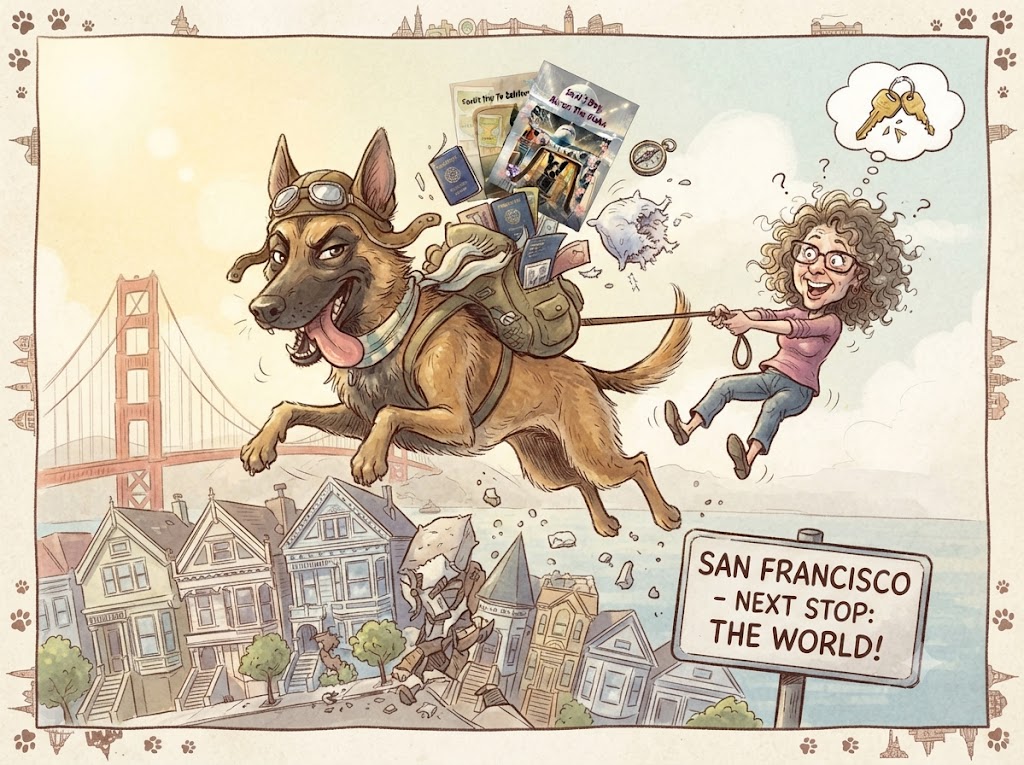
Living with a dog is typically categorized by the simple joys: the rhythmic click of nails on hardwood, the enthusiastic greeting at the door, and the comforting weight of a warm body against your legs at the end of a long day. But living with a Belgian Malinois—specifically a rescue Malinois named Sauli—is a different tier of existence entirely. It is a masterclass in vigilance, a constant game of intellectual chess, and, more often than not, a humbling lesson in the sheer ingenuity of the canine mind.
When I adopted Sauli, I did not sign up for a pet; I signed up for a lifestyle. I quickly learned that the term “escape artist” is not merely an affectionate label for a dog who likes to wander; it is a professional designation. Sauli treats every closed door, every latched gate, and every window screen not as a barrier, but as a design flaw waiting to be exploited.
The reality of living with a professional escape artist is that your home ceases to be a static space. It becomes a dynamic security environment. You stop measuring your day by the hours and start measuring it by the integrity of your perimeter. I remember the infamous “Hotel Tornado” weekend, shortly after I brought Sauli home. I had curated a peaceful, bonding experience in my mind—a gentle introduction to our new life. Instead, I found myself in a room that looked as though it had been subjected to a localized weather event. Shredded pillows were the least of my concerns. Sauli had decided that the hotel window was not a view, but an exit strategy. Her attempts to dismantle the infrastructure of that room were not driven by malice, but by a frantic, high-drive need for stimulation. She wasn’t trying to run away from me; she was trying to run toward something, anything, that could challenge her boundless curiosity.
This is the central paradox of the Belgian Malinois. They are not merely “difficult” or “naughty” in the traditional sense; they are brilliant. Their desire to escape is an expression of an intellect that refuses to be contained. If you give a Malinois a puzzle, they will solve it. If you give them a barrier, they will dismantle it. They possess a “survival intelligence” that can be both maddening and breathtaking to witness.
The frustration of this lifestyle is undeniable. There is a specific kind of exhaustion that comes from walking through your house and subconsciously checking the latch on every door, knowing that if you leave a single window slightly ajar, your dog might just engineer a grand exit. But over time, the frustration began to transmute into a form of grudging respect. I realized that Sauli wasn’t making my life difficult for the sake of it; she was holding me to a higher standard of engagement. She forced me to be present. I couldn’t zone out; I had to show up as a partner, not just a keeper.
Living with an escape artist meant that I had to start building our relationship based on trust rather than just obedience. If I wanted her to stop trying to dismantle the living room, I had to provide a more compelling challenge. We traded the “Hotel Tornado” chaos for intentional adventure. We started hiking, training, and exploring the city of San Francisco. I learned that a tired Malinois is a content Malinois, but an engaged Malinois is a companion unlike any other.
The “escape” was never about leaving me; it was about the lack of a mission. Once I became the architect of her adventures—once I started channeling her drive into purposeful tasks—the desire to dismantle the house faded. The professional escape artist was still there, of course. She still tests the locks, still eyes the fence with a strategist’s gaze, and still finds ways to make life unpredictable. But the dynamic has shifted.
Looking at Sauli today, I see the evolution of our journey together. The dog who once tried to scratch her way out of hotel rooms now curls up beside me with a sense of calm that I once thought was impossible. She is still a force of nature, but we have negotiated a truce. She taught me that life isn’t meant to be lived behind closed doors, and that sometimes, the only way to find yourself is to be brave enough to open the latch and see what’s on the other side. Living with an escape artist hasn’t just kept me on my toes; it has kept my heart wide open. And honestly? I wouldn’t have it any other way.

