
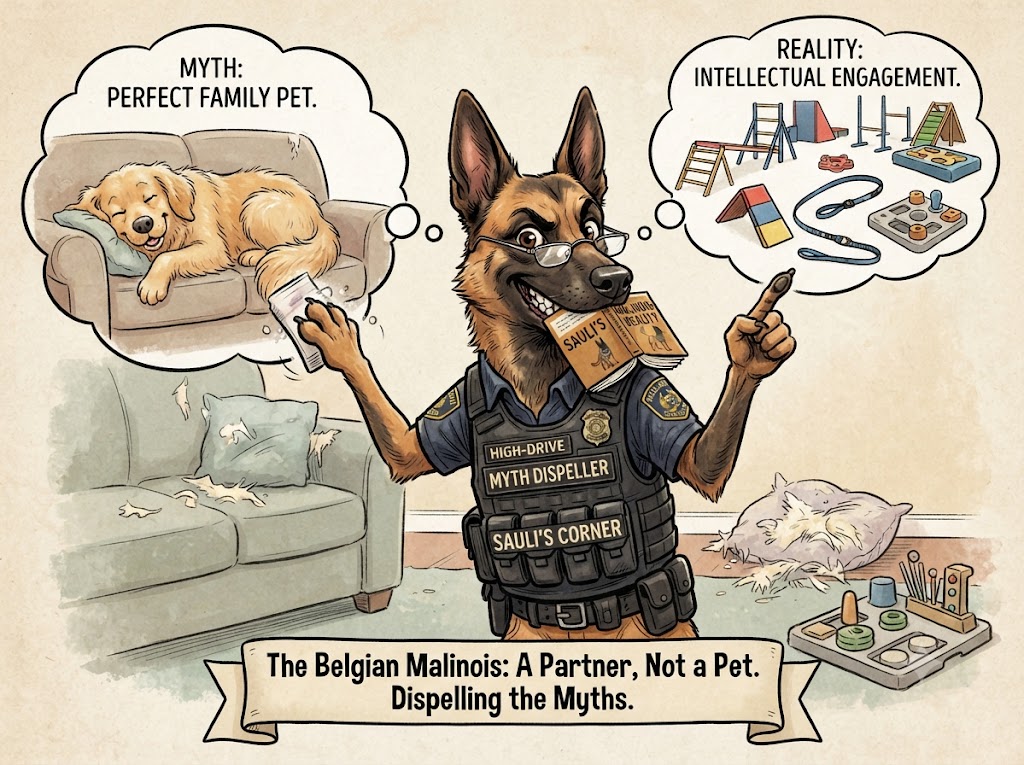
The Belgian Malinois is a breed that commands immediate respect—and often, a healthy dose of intimidation. Known for their athletic prowess, unwavering work ethic, and starring roles in military and police operations, they have become the “superstars” of the canine world. However, this popularity has a downside: a proliferation of myths that obscure the true nature of this remarkable breed. For the average person, the Malinois is often viewed through the distorted lens of Hollywood action movies, leading to a host of misconceptions that can be disastrous for unprepared owners. To truly understand the Belgian Malinois, we must peel back these layers of myth to reveal the complex, sensitive, and profoundly demanding dog underneath.Myth 1: They Are Just “German Shepherds on Steroids”
Perhaps the most persistent myth is that a Belgian Malinois is simply a more intense, athletic version of a German Shepherd. While both breeds are herding dogs that share a working heritage, they are distinct entities. A German Shepherd is often bred for a balance of work and companionship, often possessing an “off-switch” that makes them adaptable to various lifestyles. The Malinois, conversely, is bred almost exclusively for work. They are not merely “more intense”; they operate on a completely different metabolic and psychological frequency. A Malinois does not just want to do a job; they need to work to maintain their sanity. Equating them to a German Shepherd is a dangerous oversimplification that ignores the Malinois’s significantly higher drive and lower threshold for frustration.Myth 2: They Are Aggressive by Nature
Another common misconception is that the Belgian Malinois is inherently aggressive or dangerous. This myth stems from their use in protection and military work, where their biting and guarding instincts are trained and harnessed. In reality, a well-bred and properly socialized Malinois is confident, alert, and fiercely loyal, not inherently vicious. Aggression in a Malinois is typically a byproduct of fear, lack of socialization, or frustration—often caused by a dog whose intense needs have been ignored. Because they are so incredibly sharp and reactive, a Malinois that is bored or stressed can quickly manifest that energy into protective or reactive behaviors. However, this is a failure of leadership and management, not a failure of character. They are not “mean”; they are incredibly sensitive creatures who take their cues from their environment.Myth 3: They Can Be “Park Dogs”
Because of their popularity in sports and working disciplines, there is a pervasive myth that a Malinois can be satisfied by a daily game of fetch at the park. This is perhaps the most damaging myth of all. The Malinois is not an “exercise-only” breed; they are an “engagement” breed. You can run a Malinois for five miles, and they will likely return home ready for another five. Their exercise requirement is intellectual, not just physical. Without a consistent, structured job—whether it’s nose work, agility, obedience, or tracking—a Malinois will invent their own “jobs.” These often include resource guarding, destructive chewing, or, in the case of my own Malinois, Sauli, attempting to navigate hotel windows or “redecorating” living rooms. If you cannot dedicate significant time every single day to training and mental stimulation, a Malinois will likely become a source of profound stress rather than companionship.Myth 4: They Are Perfect for Families
The idea of the Malinois as a gentle family companion, in the style of a Golden Retriever, is a dangerous fantasy. While Malinois can live in family environments, they are rarely “easy” pets. They tend to be “one-person” or “one-family” dogs, and their high prey drive and intense energy can make them overwhelming for households with small children or other vulnerable pets. They often interpret the erratic movements and high-pitched noises of children as “prey,” leading to undesirable herding or chasing behaviors. A Malinois in a family home requires constant management, diligent socialization, and an owner who is as disciplined as the dog.The Reality: A Partner, Not a Pet
When we strip away these myths, what remains is the truth: the Belgian Malinois is a dog of extraordinary brilliance and sensitivity. They are not “difficult”; they are simply highly specialized. They are partners in the truest sense of the word. They ask for everything you have—your time, your attention, your consistency, and your respect—and in exchange, they give you a level of loyalty and connection that is truly transformative.
My journey with Sauli, a rescue Belgian Malinois, taught me that the “myths” often focus on the wrong thing. They focus on the dog’s capabilities rather than the human’s responsibilities. The challenge is not in the breed; it is in the lack of understanding we bring to them. If you are prepared to build a life that revolves around their need for purpose, a Belgian Malinois can be the most rewarding partner you will ever have. But if you are looking for a pet that will simply fit into your life, look elsewhere. The Malinois does not fit into your life; you must build a life around them.
 Let Your Pawrenting Journey Begin