
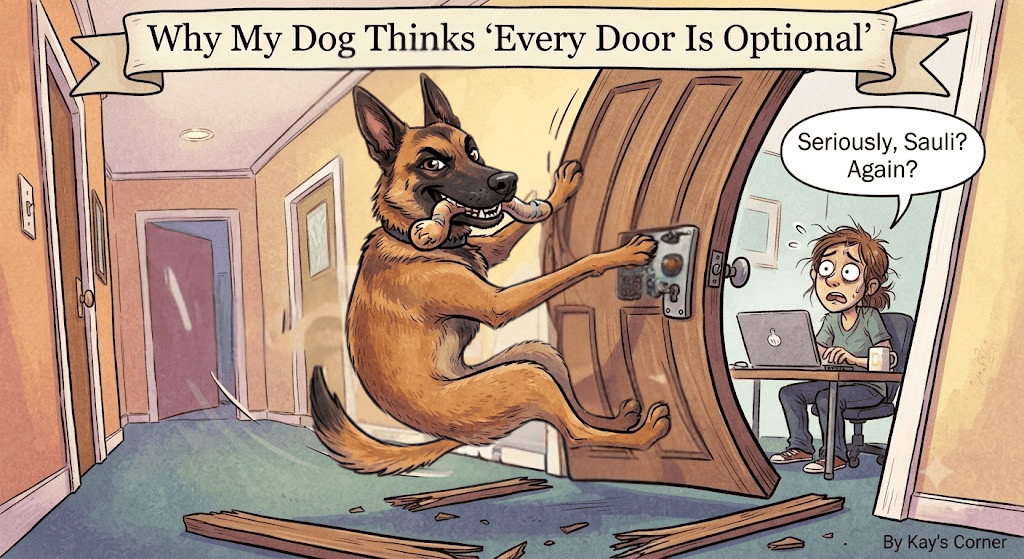
For the average homeowner, a door is a simple, functional boundary—a sturdy slab of wood or metal designed to provide privacy, security, and a quiet moment of separation from the rest of the world. It is the architectural punctuation mark that signifies the end of one space and the beginning of another. To me, a door is an invitation to a private moment or a quiet workspace. But to Sauli, my Belgian Malinois, a door is merely a suggestion—a polite barrier that she is under no legal or moral obligation to respect.
Living with a breed as high-drive and intelligent as a Malinois is an exercise in redefining one’s relationship with boundaries. Most dogs might scratch at a door, whine, or perhaps nudge it with their nose if they want to be included. Sauli, however, operates on a different operating system entirely. She doesn’t just want to be on the other side of the door; she wants to understand the physics of the door, the mechanics of the latch, and the precise moment at which the wood yields to her persistence.
Her philosophy is simple: if a space exists, it belongs to the pack. And if the pack is currently divided by a door, the door is effectively committing an act of treason against our collective unity.
I first realized the door was optional during our early days together. I had retreated to the bathroom, perhaps the only room in a house that commands a certain level of expected solitude. I had clicked the lock into place, feeling that brief, luxurious second of peace. I hadn’t even sat down before I heard the tell-tale thump-thump of paws against the other side. This was followed by a sharp, inquisitive scratch—not the desperate scratching of a panicked animal, but the precise, surgical scratching of someone trying to locate the weak point in the hinge.
Then came the silence. I sat frozen, listening. A soft click echoed through the room. I had forgotten that the latch, while secure, was not exactly reinforced against an animal who views a house not as a structure, but as a puzzle to be solved. The door creaked open, and there she stood, her ears perked forward, her expression one of utter calm and mild surprise, as if to say, “Oh, you’re in here? I thought you might be lonely.”
This wasn’t a one-off event. It was a declaration of policy.
Over the months, Sauli has refined her door-negotiation tactics. She has learned that jumping handles is far more efficient than scratching wood. She has studied the hinges of the kitchen door and realized that with enough shoulder weight applied at the right angle, the striker plate will eventually surrender. There is no door in my home that is truly “closed” in the conventional sense. A closed door is simply a closed door until Sauli decides it is an open one.
The psychological implications of this are profound. There is no “going into the other room” to escape a stressful situation or to focus on a deadline without her involvement. If I am in my office typing, Sauli will push her way in, not to demand attention, but simply to supervise the process. She believes that my productivity is a group project. If I am folding laundry, she considers the piles of clothes to be communal nesting material, and the door to the laundry room is just an unnecessary obstruction to her participation.
But beyond the annoyance, there is a strange, wild beauty to this lack of respect for architectural norms. It forces me to be present. In a world where we spend so much time building walls—physical, digital, and emotional—living with a dog who refuses to acknowledge them is a radical, albeit exhausting, lesson in radical transparency. Sauli does not believe in secrets. She does not believe in “private time.” She believes that life is best experienced as a continuous, flowing state of togetherness.
There are moments, of course, when the “optional” nature of my doors tests the limits of my patience. When I am on a high-stakes conference call and the office door swings open to reveal a dog carrying a slobbery toy, looking for a mid-meeting play session, my resolve wavers. Yet, when I look into her eyes—those eyes that saw the world through the lens of a rescue pup and now see it through the lens of a confident partner—I realize that she isn’t acting out of malice or lack of training. She is acting out of a desperate, overwhelming devotion.
She doesn’t want to break the rules; she wants to break the barriers. She wants to be exactly where I am, at all times, because she has realized that the chaos of the world is manageable only when we are together.
I’ve stopped trying to out-engineer her. I’ve accepted that my house is a fluid space, a wide-open landscape where doors are temporary inconveniences. I’ve learned to leave things cracked, to allow for the unexpected entrance, and to embrace the fact that in my home, solitude is a myth. My dog has taught me that boundaries are often just mental constructs, and that sometimes, the best way to live is to simply let the doors stay open, and to welcome whoever—or whatever—wants to walk through.
 Let Your Pawrenting Journey Begin