Forgiveness is often described as a bridge we cross to leave the past behind, yet for most humans, that bridge is narrow, rickety, and frequently revisited. We tend to hoard our grievances like precious artifacts, re-examining the sharp edges of past betrayals or mistakes until they become part of our permanent architecture. However, in the presence of a rescue dog—particularly one with the high-octane spirit of a Belgian Malinois like Sauli—one quickly learns that forgiveness is not an intellectual exercise or a moral hurdle. It is a biological necessity for survival and joy.
When I first encountered Sauli, she was a tiny black puppy with ears comically large for her head and eyes that held a wary, intelligent spark. She came with a “complex past,” a phrase that is often a euphemism for the trauma and uncertainty inherent in the rescue narrative. Bringing her home wasn’t the serene bonding experience I had envisioned. Instead, our early days were defined by the “Hotel Tornado”—a whirlwind of shredded pillows and escape attempts that tested the very limits of my patience. In those moments of frustration, looking at the wreckage of a hotel room in Wisconsin, I realized that I was holding onto a rigid set of expectations that Sauli was never meant to meet.
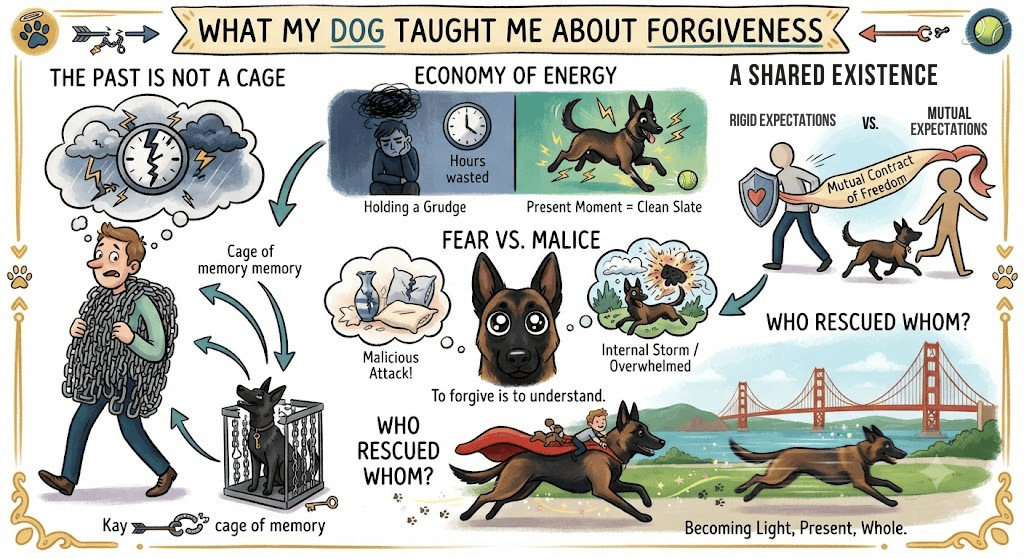
The first lesson Sauli taught me about forgiveness is that it requires an honest appraisal of fear versus malice. To forgive a dog for a shredded pillow is easy when you realize that her actions weren’t born of a desire to hurt, but from a desperate need to process the world around her. Humans, however, often struggle to apply this same grace to one another. We interpret a friend’s absence or a partner’s sharp word as a targeted attack. Sauli’s “Hotel Tornado” was a manifestation of her high drive and her history; it was her way of saying, “I am overwhelmed”. By forgiving her, I began to learn how to forgive the people in my life who were also simply acting out of their own internal storms.
Beyond the initial act of letting go, dogs offer a masterclass in the economy of energy. A Belgian Malinois is an athlete who never sleeps, a creature of intense drive and focus. For Sauli, holding onto a grudge would be an inefficient use of her vast resources. If I was late for a walk or if I had to sternly correct her behavior, she didn’t spend the next three hours brooding in the corner, replaying the “injustice” in her mind. Instead, the moment the correction passed, she returned to the present. She taught me that the present moment is too vibrant to be polluted by the dust of five minutes ago. To a dog, every moment is a clean slate—a concept that is the very essence of unconditional love.
This “survival intelligence” is something that rescue dogs possess in abundance. Because Sauli has known loss and uncertainty, her loyalty is not a given; it is a hard-won treasure. This taught me that forgiveness is also a form of trust. When a rescue dog finally rests their head on your lap after hours of mischief, they are forgiving you for the world’s previous unkindnesses. They are choosing to trust that this human, in this moment, is safe. It is a monumental act of courage. It reminded me that our own inability to forgive others is often just a shield we use to avoid being vulnerable again. Sauli chose to drop her shield, forcing me to drop mine.
The shift in my perspective occurred when I realized that forgiveness is a mutual contract of freedom. I thought I was the one doing the forgiving—forgiving the chewed shoes, the escape attempts through hotel windows, and the midnight mayhem. But in reality, Sauli was forgiving me for my rigidity, my impatience, and my desire for a “sterile order” in a life that was meant to be beautifully chaotic. She moved me from being a self-appointed savior to being a partner in a shared existence.
Patience is the currency of this partnership. With a high-energy rescue, trust is earned in millimeters, not miles. This slow progression teaches you that forgiveness isn’t a one-time event; it’s a daily practice. It is the decision to wake up every morning and see the dog (or the person) in front of you as they are now, rather than as the version of them that failed you yesterday.
Ultimately, Sauli taught me that the cage of memory is one we often lock from the inside. We think we are protecting ourselves by remembering every slight, but we are actually just preventing ourselves from running free. Watching Sauli zoom through a park in San Francisco, her black fur a flash of pure, unburdened speed, I see what happens when you truly let go. You become light. You become present. You become whole. The “rescue” was never just about giving a dog a home; it was about a dog showing a human how to find a home in the present moment, free from the weight of the past. And in that realization, I finally understood who rescued whom.
 Let Your Pawrenting Journey Begin