
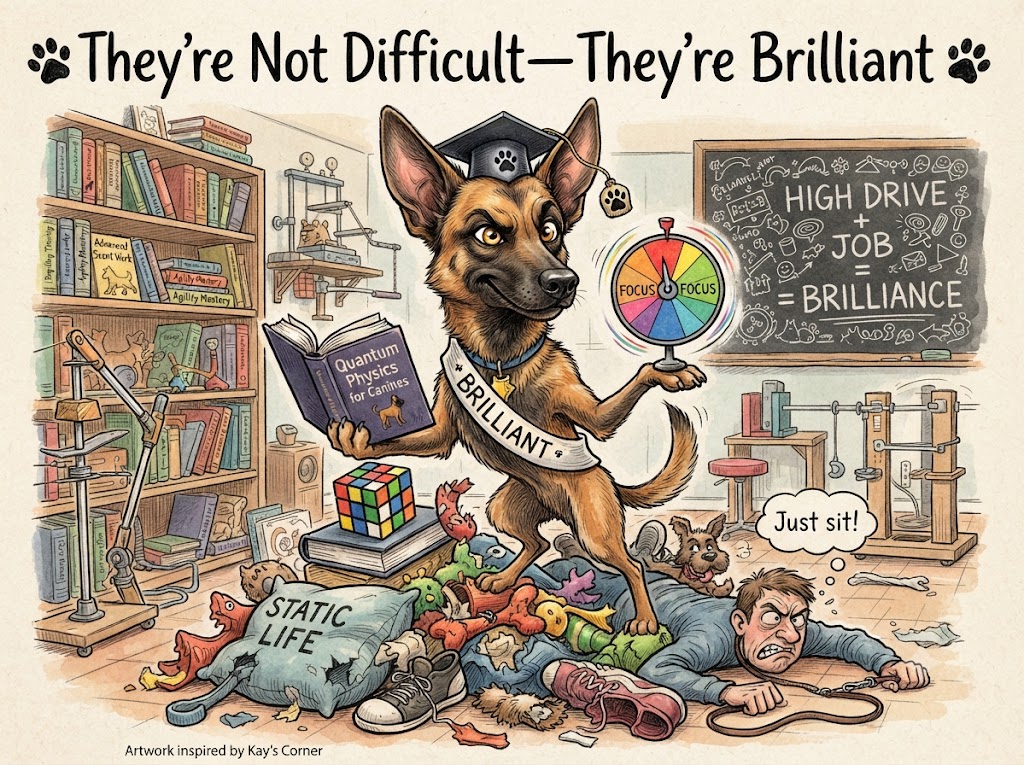
The Belgian Malinois is often the most misunderstood dog in the modern canine world. To the casual observer or a prospective owner unprepared for the breed’s intensity, the Malinois appears “difficult”—demanding, relentless, and occasionally overwhelming. They are frequently mislabeled as “hyperactive” or “aggressive” by those who measure dog behavior through the lens of a passive family pet. However, this assessment is not just reductive; it is fundamentally flawed. To call a Belgian Malinois “difficult” is to mistake brilliance for inconvenience. They are not difficult; they are, in every sense of the word, brilliant.
The “difficulty” associated with the Malinois is a direct byproduct of their singular evolutionary purpose: work. Developed in Belgium as an all-around herding dog, the Malinois was never bred to spend sixteen hours a day lounging on a sofa. They were bred to partner with humans in complex tasks, requiring immediate responsiveness, high environmental awareness, and a drive to exert control over their surroundings. When a Malinois is placed in a static, low-stimulation environment without a “job,” their legendary intelligence—which should be channeled into problem-solving and task mastery—naturally turns inward, manifesting as destructive behavior, obsessive habits, or excessive vocalization. This is not a flaw in the dog; it is a mismatch of expectations.
When we look at the Malinois through the correct lens, what we see is a breathtaking level of cognition. A Malinois does not just “learn” a command; they analyze the context. They are arguably the most sensitive breed to human body language and intent, which is precisely why they excel in military, police, and search-and-rescue roles across the globe. Their ability to process information at high speeds allows them to navigate complex, changing environments that would leave other breeds confused or overstimulated. To a Malinois, the world is a series of puzzles to be solved, and they are always searching for the next piece of the riddle.
Their high drive—often the primary complaint of the “difficult” label—is actually a superpower of focus. A Malinois in “work mode” displays a level of concentration that is almost human-like in its intensity. They possess a deep-seated desire to cooperate with their handler, a trait that creates the potential for a bond that is arguably closer than any other pairing in the animal kingdom. When they are properly trained, they are not robotically obedient; they are actively participating in a shared endeavor. They are collaborative athletes, not just pets.
The mistake many owners make is attempting to “tame” the Malinois rather than partnering with them. A Malinois cannot be forced into a mold of passive obedience; they must be managed through structured engagement. Brilliant dogs require a brilliant handler—someone who understands that mental exercise is far more exhausting and fulfilling than physical exercise alone. Training a Malinois requires a mastery of timing, a deep understanding of motivation, and an appreciation for their unique psychology. It is an education for the owner as much as it is for the dog.
When you provide a Malinois with an outlet for their brilliance—be it agility, scent work, obedience training, or protection sports—the “difficult” dog disappears. In their place emerges a creature of immense capability and loyalty. They become a partner who anticipates your moves, supports your goals, and brings a level of enthusiasm to your life that is unmatched. They do not just live alongside you; they live for you.
The label of “difficult” is an indictment of our own limitations as owners, not a statement on their nature. If we treat a Ferrari like a family sedan, we shouldn’t be surprised when the engine burns out. The Belgian Malinois is an elite athlete, a high-performance machine of nature, and a testament to the power of human-canine partnership. They do not ask for an easy life; they ask for a meaningful one. If you can provide that, you will find that you haven’t just adopted a dog—you have gained a brilliant companion who will challenge you, push you, and ultimately change the way you see the world.

