
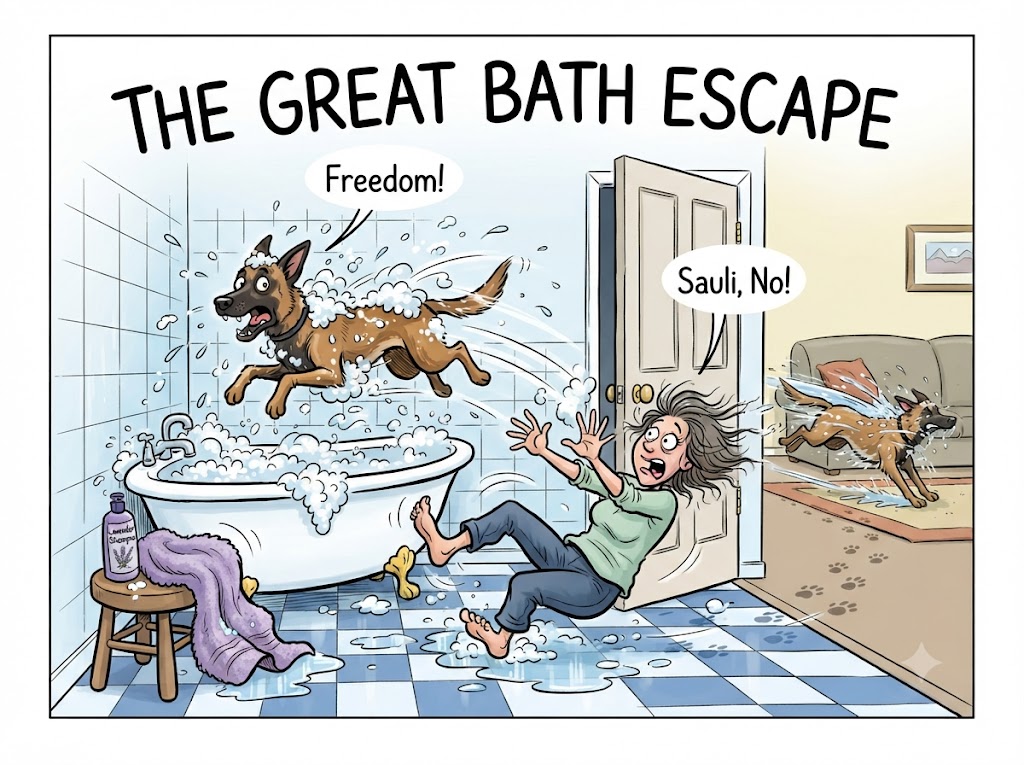
The bathroom, for most dogs, is an unremarkable tile-lined room. It is a place of cold surfaces, echoing acoustics, and the occasional forbidden sip from the toilet bowl. But for Sauli, my Belgian Malinois, the bathroom was not a room; it was a theater of war. It was the place where the dignity of the rescue pup was stripped away, replaced by the indignity of warm water, lavender-scented shampoo, and a towel that felt suspiciously like a cage.
The tension began long before the actual bathwater started to run. It began with the sound. The click of the bathroom door handle was all it took. In any other circumstance, Sauli was a paragon of obedience, or at least a very good listener. But the moment the porcelain tub began to fill, she became a phantom. She didn’t growl, and she didn’t bark; she simply evaporated. She would melt into the shadows of the hallway, ears pinned back, her intelligent eyes tracking my every movement with the intensity of a predator watching a rival.
“Sauli,” I would call, my voice feigning a casualness I definitely did not feel. “Come here, sweet girl.”
The silence that followed was heavy. It was the silence of a dog who knew exactly what was coming. When I finally found her, she was usually wedged in the farthest corner of the apartment, behind a bookshelf, looking like a statue of regret. Extracting her was a chore of negotiation. I had to offer treats, sweet talk, and eventually, a gentle, coaxing guide. She walked toward the bathroom as if she were marching toward the gallows, her paws dragging against the hardwood floor with a rhythmic scritch-scratch of protest.
Once inside the bathroom, the door was firmly shut. This was her first clue: the “Great Bath Escape” had commenced.
For a Belgian Malinois, intelligence is a double-edged sword. She understood the geometry of the room. She knew the distance between the sink and the door. She knew exactly how much force was required to nudge the handle. While I scrambled to gather the shampoo and the towel, Sauli was conducting a tactical assessment. She didn’t struggle when I lifted her into the tub; she went limp. This was her “passive resistance” phase. She would stand there, perfectly still, looking at the ceiling with an expression of stoic martyrdom, waiting for a single lapse in my concentration.
The water poured, and the shampoo lathered. That was the moment of explosion.
It wasn’t a slow crawl. It was a physics-defying launch. One moment, she was a wet, soapy dog in the tub; the next, she was a blur of black fur, a projectile launched into the middle of the room. The sheer velocity with which a Malinois can exit a confined space is truly something to behold. She hit the floor, her paws finding traction on the slick tiles with a frantic scramble, and she was off.
The escape was not just a run; it was a full-scale tactical maneuver. She banked off the toilet, dodged my grasping hands, and threw herself toward the door. I lunged, but I was hindered by my own soapy hands. I felt like a cartoon character slipping on a banana peel, my feet sliding across the wet tiles while she darted into the hallway like a shadow seeking the light.
She didn’t run to hide. She ran to reclaim her territory. She sprinted through the apartment, a streak of white suds and water, shaking herself with such vigor that the living room walls were suddenly speckled with water. She felt, for those glorious seconds, that she had won. She was free. She was no longer a captive of the bathroom; she was the queen of the rug.
But the “Great Bath Escape” always had a second act. As I stood in the doorway, catching my breath and surveying the carnage—wet sofa cushions, a dripping floor, and a triumphant dog sitting in the center of the room—I realized that she wasn’t just running away. She was running toward me, in her own way. She came back, eventually, when the adrenaline faded and the absurdity of the situation settled in.
I would sit on the floor, defeated, and she would finally approach, hesitant but curious. She would sniff the soapy air, look at me with those large, intelligent eyes, and give a tentative, apologetic lick to my hand. In that moment, the bath didn’t matter. The shredded pillows of the past, the broken lamps, and the soap-covered walls were just footnotes in our shared history.
The bath was a battle, yes. But looking at her, shivering slightly in her damp coat, I knew that the “Great Bath Escape” wasn’t really about escaping me. It was about the wild, fierce, independent spirit that had made me fall in love with her in the first place. She was a rescue pup who had learned to fight for her autonomy, and even if that fight was only over a bottle of dog shampoo, it was a testament to the fact that she was truly, finally, alive.
We would dry off together, me with a towel and her with a series of frantic, joyous rubs against the furniture, our truce restored until the next time the bathtub clicked open. The Great Bath Escape was a messy, loud, and utterly exhausting affair, but it was our affair. And I wouldn’t trade the chaos for anything.

