
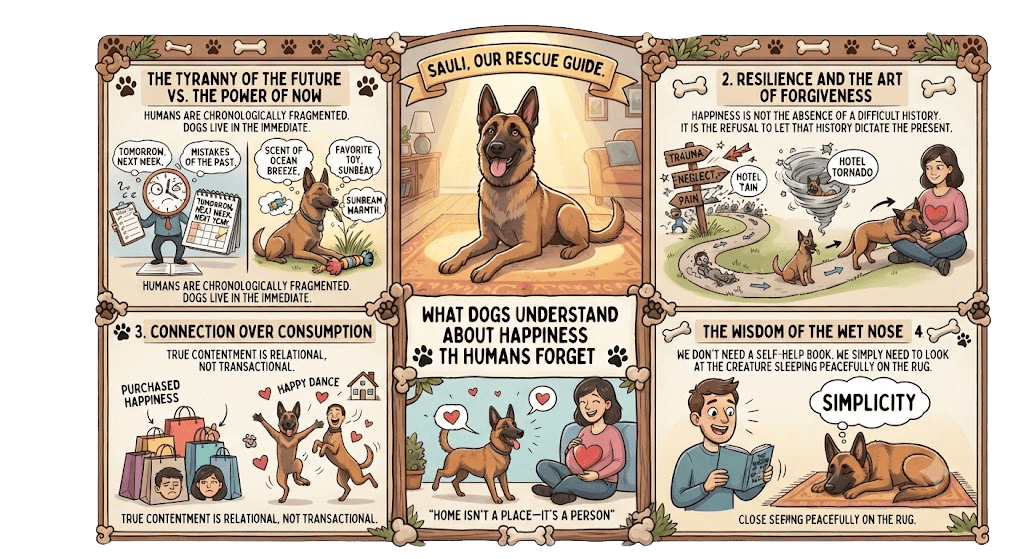
Humans often treat happiness as a distant destination—a summit reached through career milestones, material accumulation, or social validation. We spend our lives building elaborate “cages” of stress and schedules, hoping that the structure we create will eventually yield peace. Yet, in the quiet corners of our homes, a different philosophy is being practiced. Dogs, like the Belgian Malinois rescue Sauli, live as if happiness is not a reward to be earned but a natural state of being. By observing their resilience and presence, we can rediscover the fundamental truths of joy that we have allowed our modern complexities to obscure.
The Tyranny of the Future vs. The Power of Now
The most profound difference between human and canine happiness lies in our relationship with time. Humans are chronologically fragmented; we ruminate on the mistakes of the past and fret over the uncertainties of the future. We live according to rigid “to-do lists” that prioritize productivity over presence. Sauli, by contrast, possesses an absolute indifference to my calendar. Her world is defined entirely by the immediate: the scent of an ocean breeze, the texture of a favorite squeaky toy, or the warmth of a sunbeam on the living room rug.
When we walk, humans often view the path as a means to an end—a way to reach a destination or fulfill a step count. To a dog, every walk is an adventure in itself. They understand that happiness is found in the nuances of the journey—in the millions of stories told through a single blade of grass or the shifting wind. By constantly looking ahead, humans forget that the only place joy can actually be experienced is in the present moment.
Resilience and the Art of Forgiveness
In the world of animal rescue, we witness a type of “survival intelligence” that many humans struggle to emulate. Dogs like Sauli often arrive with complex pasts, having known trauma, neglect, or the pain of being unwanted. While humans might carry such wounds as permanent filters for their worldview, dogs demonstrate an incredible capacity for healing. They move through the “Hotel Tornado” phases of life—the chaos, the escapes, and the fear—to eventually rest their heads on a lap in a gesture of absolute trust.
Happiness, for a dog, is not the absence of a difficult history; it is the refusal to let that history dictate the present. They choose trust over suspicion and play over rumination. When a rescue dog decides to love again, it is a monumental act of courage that serves as a reminder to humans that we, too, can find room for a new chapter regardless of the “cages” we have previously inhabited.
Connection Over Consumption
Modern human society is built on the premise that happiness can be purchased. We seek fulfillment in things, yet we find that material joy is fleeting. Dogs remind us that true contentment is relational, not transactional. As Sauli’s journey illustrates, “Home isn’t a place—it’s a person”. A dog does not care about the square footage of the house or the prestige of the zip code; they care about the quality of the connection with their “hooman”.
This loyalty is not a given; it is earned through shared experiences and the quiet power of being chosen. In the simple act of leaning into a touch or greeting a loved one at the door with a “happy dance,” dogs prioritize the human-dog bond over all else. They understand that happiness is found in belonging and the realization that the best way to find oneself is to get lost in the service and love of another.
The Wisdom of the Wet Nose
Ultimately, what dogs understand—and humans forget—is that happiness is found in simplicity. It is found in the “unexpected wisdom of wet noses” and the realization that we don’t need a perfect life to be happy. We don’t need a self-help book to learn how to live; we simply need to look at the creature sleeping peacefully on the rug.
Sauli’s transformation from a scared rescue puppy into a confident, joyful companion is not just her success story; it is a lesson for her pawrent. She moved me from a life of sterile order to one of beautiful, chaotic meaning. In teaching us how to care for them, dogs teach us how to care for ourselves—by showing us how to be patient, present, and resilient. As we navigate our own journeys, we would do well to keep our hearts open to the adventure, just as Sauli did on her long road trip to California, trusting that home is wherever we are loved.
 Let Your Pawrenting Journey Begin