
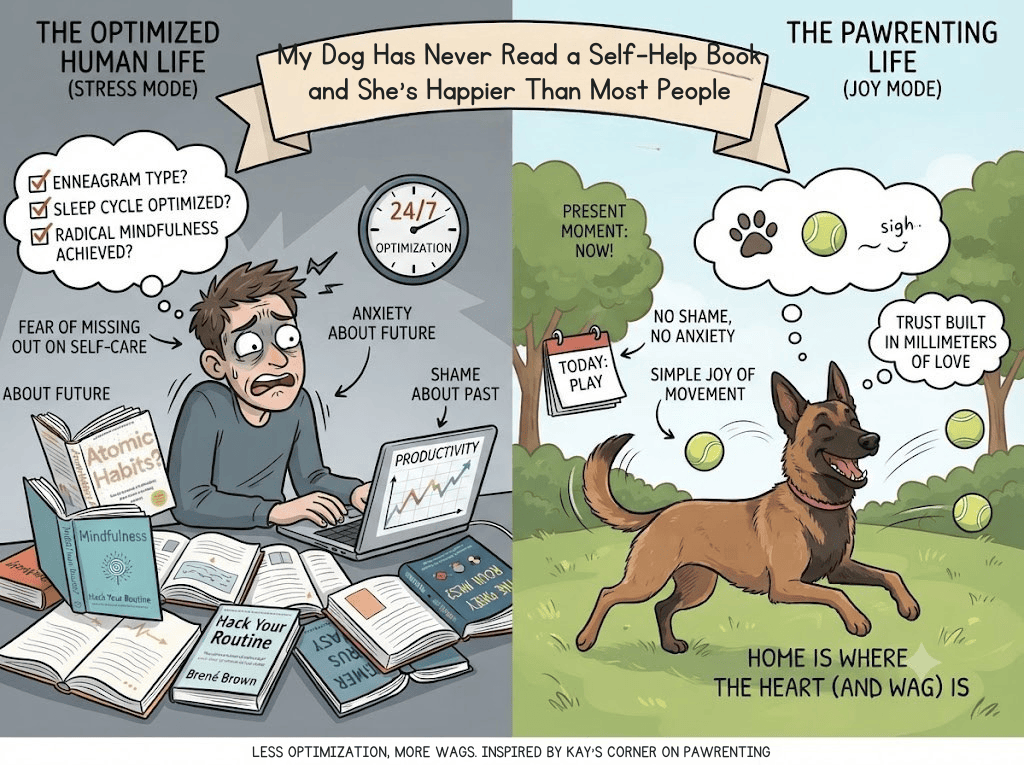
My nightstand is a quiet graveyard of good intentions. It is stacked with the heavy hitters of modern self-improvement: books on habit-stacking, guides to radical mindfulness, and manifestos on how to “hack” your morning routine for peak productivity. Each volume promises a version of me that is more optimized, more peaceful, and somehow more “arrived.” Yet, as I sit there highlighting passages on how to be present, I often find myself looking down at Sauli, my Belgian Malinois rescue, who is currently attempting to fit three tennis balls in her mouth simultaneously.
Sauli has never read a single page of Brené Brown. She doesn’t know her enneagram type, she hasn’t optimized her sleep cycles, and she certainly doesn’t practice “intentional breathing.” And yet, she possesses a grounded, vibrant contentment that I—with all my folders of notes and podcast bookmarks—frequently struggle to touch.
The Tyranny of the Optimized Life
We live in a culture obsessed with fixing the human condition. We treat our lives like software that needs constant patching. We are told that if we just find the right strategy, the right morning ritual, or the right mindset shift, we will finally unlock the door to happiness. This pursuit, while noble in its intent, often creates a secondary layer of anxiety: the fear that we aren’t doing “self-care” correctly.
Then there is the Belgian Malinois. Sauli is a high-drive, high-energy “tornado on four legs”. When we first met in Wisconsin, she didn’t wait for a formal introduction to show me who she was. She was a whirlwind of shredded pillows and escape attempts. In those early days, particularly during the infamous “Hotel Tornado” weekend, I tried to apply my human logic to her chaos. I wanted her to be “calm.” I wanted a “curated” bonding experience.
But Sauli taught me that life isn’t something to be curated; it’s something to be lived. She didn’t need a 5-step guide to trust me; she just needed a consistent bowl of kibble and the realization that we had survived the storm together.
The Master of the “Now”
The cornerstone of almost every self-help book is the directive to “be here now.” We spend billions of dollars on apps and retreats to learn how to inhabit the present moment. For Sauli, the present isn’t a destination she works toward; it’s the only place she lives.
When Sauli chases a ball in a San Francisco park, she isn’t thinking about the “Great Escape” she attempted in Wisconsin or the time she got fired from daycare. She isn’t worrying about whether she’ll be a “good dog” tomorrow. There is no shame about the past and no anxiety about the future. There is only the flight of the ball, the scent of the grass, and the pure, kinetic joy of movement.
Humans are the only species that spend our “now” worrying about our “then.” We carry the weight of yesterday’s mistakes like a heavy pack, and we scan the horizon for tomorrow’s threats. Sauli reminds me that every walk is an adventure if you let it be. To her, a rainy day isn’t a ruined schedule; it’s a new set of smells and a chance to snuggle closer on the couch.
Connection Over Complexity
In our quest for better relationships, we often turn to complex communication strategies and psychological frameworks. We guard our hearts, we wait for the “right time” to be vulnerable, and we measure our loyalty against transactional metrics.
Sauli’s approach to connection is embarrassingly simple. It is built in millimeters of trust, not miles of strategy. When she rests her head on my lap, it isn’t because she has processed her “attachment style”; it’s because she has decided, against her previous experience as a scared rescue, that the world is safe again.
This is the “unexpected wisdom of wet noses”. Dogs don’t fake their emotions. If she is happy, her whole body wiggles; if she is wary, her intelligence sparks in her eyes. There is a profound honesty in that simplicity. She doesn’t need a book to tell her that love is a mutual contract of showing up—not as a savior, but as a partner.
The Mutual Rescue
Ultimately, the contrast between the self-help shelf and the dog on the rug comes down to the source of joy. Self-help often looks inward, focusing on the “I.” Sauli looks outward, focusing on the “Us.”
I thought I was the one doing the rescuing when I clicked “submit” on that adoption form. I thought I was bringing her home to give her a better life. But the truth is more nuanced. Sauli rescued me from my own rigid schedules and my sterile desire for order. She forced me to trade my to-do lists for the rhythm of a wagging tail.
We don’t need more “hacks” for happiness. We need to be more like the Belgian Malinois who thinks rules are suggestions but loyalty is absolute. We need to realize that home isn’t a place we reach through self-optimization; it’s a feeling of belonging that we find when we stop trying to “fix” ourselves long enough to realize we are already chosen.
Sauli may never read a self-help book, but every time she nudges my hand with her cold, wet nose, she teaches me the most important lesson of all: the best way to find yourself is to get lost in the beautiful, chaotic life of another living being.
 Let Your Pawrenting Journey Begin