
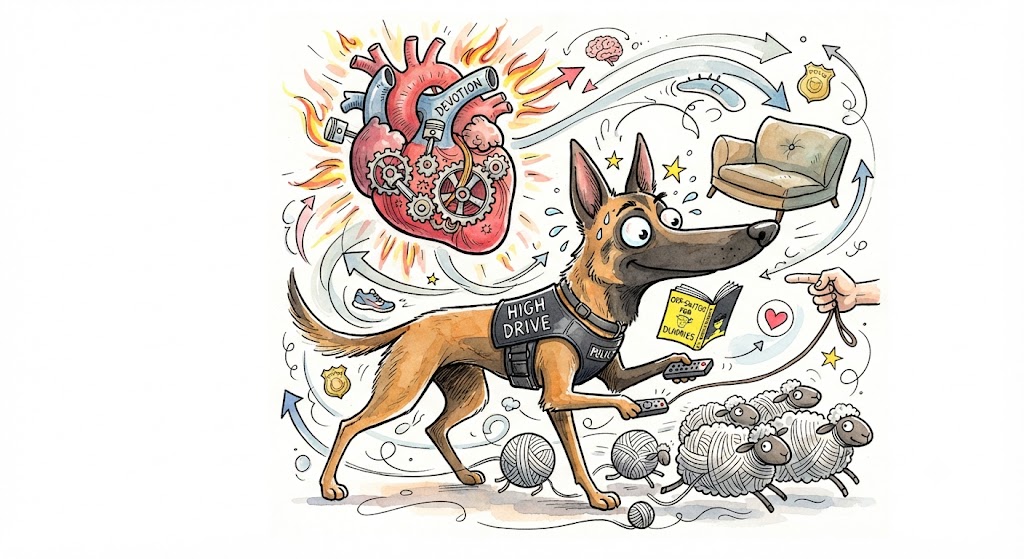
In the world of working dogs, few breeds elicit as much polarized fascination as the Belgian Malinois. To the uninitiated, they are often mistaken for the more common German Shepherd, only to be quickly distinguished by a sharper, leaner frame and an intensity that seems to vibrate off them like heat from pavement. They are the athletes of the canine world, the marathon runners, the tireless workers that police departments and special forces gravitate toward because they do not simply perform a task—they become the task. But beneath the stoic, high-drive exterior that has defined their reputation lies a heart that is frequently misunderstood. To live with a Belgian Malinois is to learn that their “high drive” is not merely a tool for utility; it is the very essence of their capacity for profound, unwavering love.
When people speak of a dog’s “drive,” they are usually referring to their motivation to hunt, track, protect, or play. In the Malinois, this drive is a living, breathing engine. It is an evolutionary legacy that demands purpose. For a breed developed to guard and herd on the vast plains of Belgium, idleness is the antithesis of their nature. They were not designed to lie on a couch for eight hours while their human is away; they were designed to manage, to move, and to engage. Yet, this high-octane personality is precisely what makes them so challenging for the casual pet owner—and so rewarding for the partner who understands them.
There is a common misconception that because the Malinois is an intense, task-oriented animal, they are cold or purely transactional. Nothing could be further from the truth. Their intensity is, in fact, the key to their attachment. Because they are driven to engage so deeply with their environment, they channel that same, laser-focused intensity into their human relationships. If a Malinois chooses you, they do not just “like” you; they tether their existence to yours. They are the ultimate “velcro dogs,” not because they are needy, but because they are hyper-aware. They are constantly reading the room, checking in on your mood, and scanning for ways to be useful. Their high drive means that when they are with you, they are all in.
The heart of the Malinois is forged in partnership. They are not dogs that exist well in isolation or in environments where they are treated as an afterthought. Their brilliance is not merely a product of training; it is a manifestation of their need to operate in tandem with a leader. When you work with a Malinois, you are engaged in a constant, silent conversation. You see it in the way they look at you—not with the casual glance of a pet, but with the focused, searching gaze of a coworker waiting for the next command. This connection creates a level of synchronicity that is breathtaking to experience. You stop being a “dog owner” and start being a team.
However, it is crucial to recognize that this drive requires a responsible hand. Loving a high-drive dog means respecting their biology. Many people acquire a Malinois because they are impressed by the breed’s capabilities, but they fail to account for the emotional labor involved in stewardship. If you do not provide them with an outlet for their intensity—if you do not give them a “job,” whether that is agility, scent work, or simply the mental stimulation of rigorous training—that drive will inevitably implode. It manifests as anxiety, destruction, or, most tragically, a breakdown of the bond between dog and human.
To love a Malinois is to accept a lifestyle shift. It means prioritizing their need for movement and mental stimulation above your own desire for rest. It means understanding that their “high drive” is an expression of their intelligence and their desire to cooperate. When you meet that drive halfway, the reward is an unparalleled depth of connection. You begin to understand that their restlessness is simply a desire to keep the world in order, and their intensity is just a reflection of their dedication to you.
The “heart” behind the high drive is one of singular, focused devotion. The Belgian Malinois asks for a lot—they ask for your time, your patience, and your presence—but they give back exponentially. They remind us that the best parts of life are found when we are fully engaged, when we are working toward a goal, and when we are inextricably linked to someone who shares our rhythm. They are not for everyone, and that is as it should be. But for those who are willing to bridge the gap between their need for activity and their capacity for love, the Belgian Malinois is not just a dog; they are a transformative force that makes the world feel smaller, safer, and far more connected.

