Lessons in Presence and the Art of Silent Partnership
In our hyper-connected, linguistically saturated world, we often mistake communication for connection. We fill our silences with podcasts, our screens with endless scrolls, and our relationships with explanations and justifications. We live in a state of perpetual “to-do” lists, rarely pausing to simply exist. Yet, for those of us who have shared a home with a dog, there is a quiet revolution happening at the level of our knees. It is the wisdom of the wet nose—a silent, damp, and persistent nudge that reminds us that the most profound lessons in life require no words at all.
Living with Sauli, a high-drive Belgian Malinois rescue, taught me that my definition of a “savior” was entirely misplaced. I thought I was the hero of the story, rescuing a creature from a cage. I quickly realized that the cage I was actually opening was my own rigid adherence to schedule and success. Dogs do not offer us advice; they offer us their presence. They do not critique our past or worry about our future; they simply witness our “now.”
The Silence of Understanding
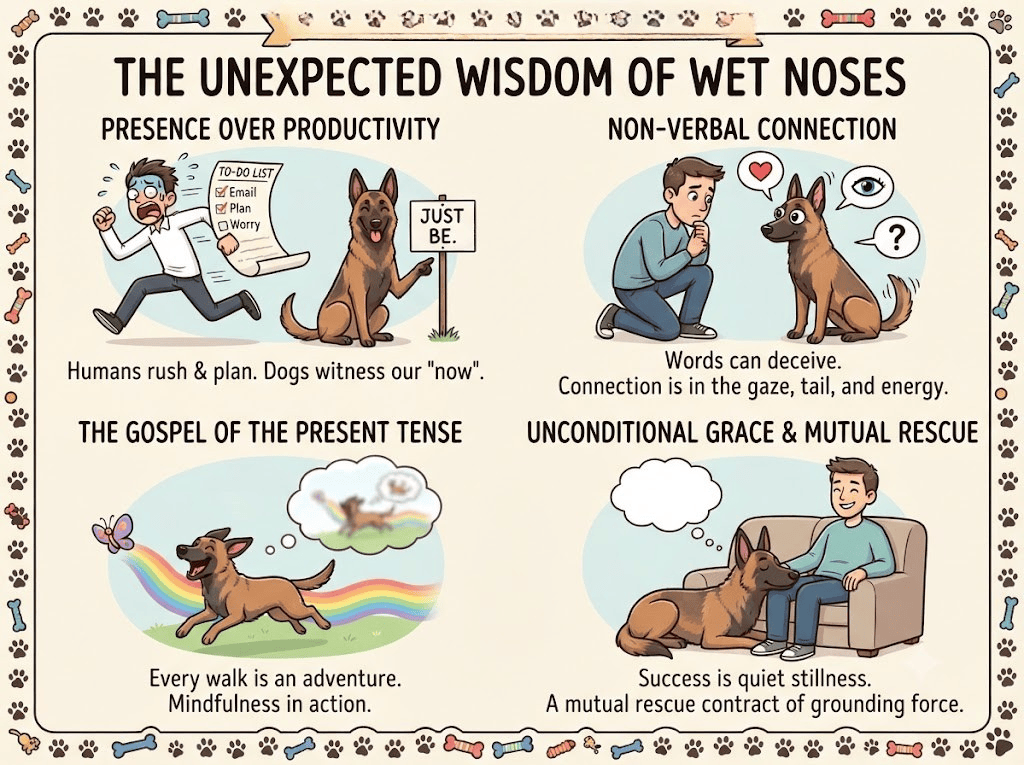
One of the first things a dog parent learns is that words are often the least effective way to communicate. Human language is a tool for complexity, but it is also a veil for deception. Dogs, however, are masters of the non-verbal. They communicate through the tilt of a comically large ear, the frantic rhythm of a wagging tail, or the quiet intensity of a gaze.
When Sauli first arrived, our communication was a “delicate dance of introduction,” a silent conversation where she sized me up as much as I did her. She wasn’t looking for a list of my accomplishments; she was looking for a partner. This non-verbal exchange forces a human to slow down and listen with their eyes. We begin to understand the “survival intelligence” of a rescue dog—the way they read our energy before we even realize we’ve shifted from calm to stressed. This wisdom teaches us that true connection isn’t built on what we say, but on how we show up.
The Gospel of the Present Tense
We humans are time travelers. We are almost never in the room we are actually sitting in. We are reliving a meeting from three hours ago or rehearsing a conflict that might happen tomorrow. Dogs, conversely, are the ultimate practitioners of mindfulness. To a dog, every walk is a new adventure, even if it’s the same path we’ve trodden a thousand times.
I remember the “Hotel Tornado” weekend—a whirlwind of shredded pillows and escape attempts that felt like a disaster to my orderly mind. To Sauli, it wasn’t a “disaster”; it was an exploration. She wasn’t ruminating on the foster home she left or worrying about the San Francisco apartment she hadn’t seen yet. She was entirely invested in the potential of a hotel toilet paper roll.
When we watch a dog sleep peacefully in a sunbeam or chase a ball with unbridled joy, we are seeing the gospel of the present tense in action. They remind us that happiness is not a destination we reach after completing a to-do list; it is the quality of our attention to the current moment.
Redefining Success and Unconditional Grace
In a world that measures success by productivity, dogs offer a radical alternative. To a dog, success is a successful sniff of a blade of grass, a night without an escape attempt, or the moment they finally decide to rest their head on your lap. They teach us that success is often found in the “quiet stillness” of a shared moment rather than the completion of a task.
Perhaps the most challenging wisdom they offer is the lesson of unconditional grace. Human forgiveness is often transactional, but a dog’s love has no ego. They do not hold grudges for the walk that was ten minutes late or the dinner that was slightly delayed. They reflect back to us our own capacity for compassion, showing us that loyalty is a “hard-won treasure” earned through millimeters of trust.
The Mutual Rescue
Ultimately, the wisdom of wet noses leads us to a humbling realization: the “rescue” is a mutual contract. We provide the roof, the name, and the kibble, but they provide the grounding force that keeps us from drifting away into our own mental anxieties. They move us from a life of sterile order to one of beautiful, chaotic meaning.
When a dog like Sauli finally rests her head on your lap after weeks of wary observation, it is a monumental act of courage that no human word could ever replicate. It is a silent declaration that the world is safe again. In teaching us how to care for them, they inadvertently teach us how to care for ourselves. We find that the best way to find ourselves is to get lost in the simple, honest, and wordless life of another soul.
We don’t need a self-help book when we have a dog; we just need to pay attention to the nudge of a wet nose. It is the only compass we really need to find our way back to the present.

