In the world of working dogs, few breeds are as frequently conflated as the Belgian Malinois and the German Shepherd Dog (GSD). At a glance, their shared heritage as herders and their common presence in police and military service make the confusion understandable. However, to the seasoned “pawrent” or a professional handler, these two breeds are as different as a refined sedan and a high-performance Formula 1 car. Understanding these distinctions is not merely an academic exercise; it is a critical safety and lifestyle requirement for any potential owner.
The Physical Framework
The most immediate differences are found in their silhouettes. A German Shepherd is a medium-to-large “rectangular” dog, characterized by a heavier bone structure and a coat that often appears more voluminous. They are built for power and endurance over long patrols.
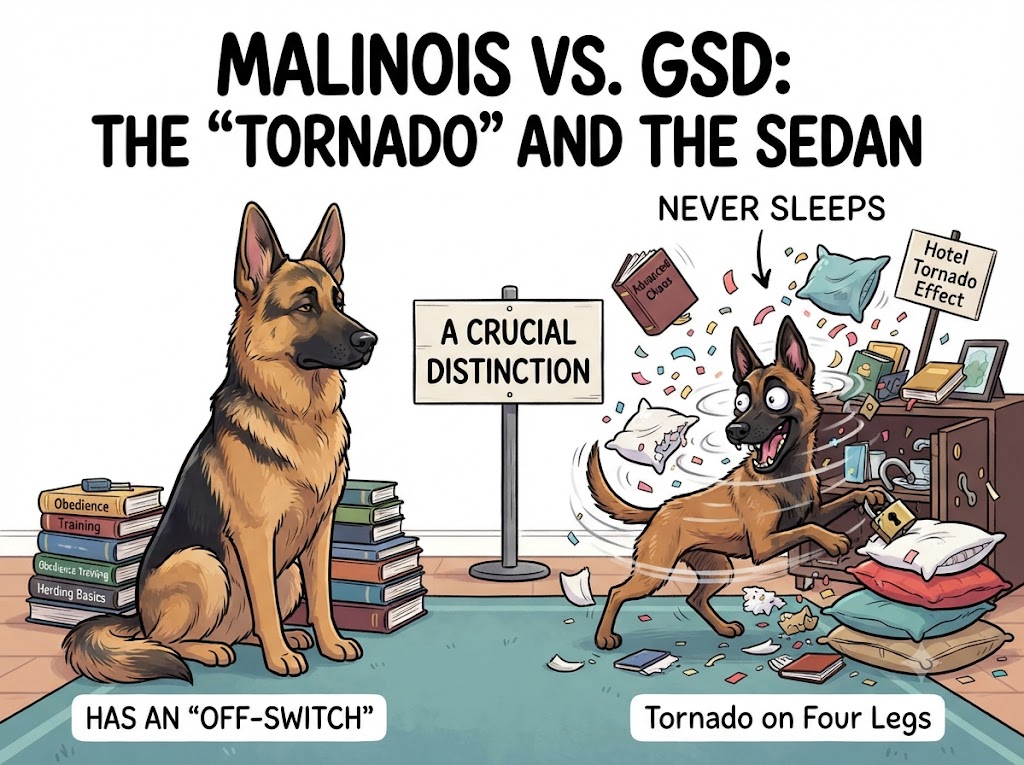
In contrast, the Belgian Malinois is a “square” dog—frequently smaller, leaner, and far more lithe. While a GSD may possess a sloping back, the Malinois carries a level topline and a sleek, short coat that offers little resistance during high-speed maneuvers. This physical lightness contributes to the Malinois’ reputation as a “black whirlwind” or a “tornado on four legs”.
| Feature | German Shepherd Dog | Belgian Malinois |
|---|---|---|
| Build | Heavy, rectangular, powerful | Lean, square, lithe |
| Weight | 50–90 lbs | 40–80 lbs |
| Coat | Double coat, thicker, sheds heavily | Short, straight, weather-resistant |
| Stance | Often has a sloping topline | Level topline |
Temperament and The “Intensity” Gap
The true divide between these breeds lies in their mental architecture. German Shepherds are renowned for their discerning nature; they are often described as protective, loyal, and possess an “off-switch” that allows them to settle into home life after a day of work. They tend to observe before they act.
The Belgian Malinois, however, is a high-drive athlete that never truly “sleeps” in the way a typical pet might. They possess a “survival intelligence” and a “wild spark” that demands constant engagement. While a German Shepherd might wait for a command, a Malinois often anticipates the command or creates its own “job”—which frequently leads to the “Hotel Tornado” effect seen in new rescue experiences where pillows are shredded and mini-bars are investigated with surgical precision.
The Malinois is often described as a “velcro dog,” but with a level of intensity that can be overwhelming. They do not just want to be near you; they want to be a partner in every action. As noted in the experiences of Sauli’s owner, a Malinois is not a passive recipient of care but a force of nature that demands a partner, not a savior.
Energy Levels and Exercise Requirements
While both breeds require significant exercise, the Malinois operates on a different plane of energy. A German Shepherd is content with a vigorous long walk and some mental stimulation. A Malinois requires more than just exercise; they require a mission.
Without a dedicated “job”—be it agility, advanced obedience, or scent work—the Malinois will find ways to entertain itself. These “adventures” often include:
- Escape Artistry: Developing “Houdini-like” skills to manipulate locks, doors, and even windows.
- Nocturnal Mischief: Using “pat-pat-pat” tactics to test boundaries while the owner sleeps.
- High-Speed Zoomies: Transforming a living room into a blur of black fur and kinetic energy.
Training and Care: The Partnership Model
Training a German Shepherd often focuses on obedience and structure. Training a Malinois, however, is a long-term contract of mutual trust. Because they are so highly sensitive and intelligent, they can quickly distinguish between a command and a connection. They require a handler who is present, patient, and resilient.
The specific care requirements for a Malinois include:
- Mental Enrichment: They need cognitive challenges to prevent the “CEO of Chaos” persona from taking over.
- Firm Boundaries: Their intelligence allows them to view “rules as suggestions” if not consistently reinforced.
- Trust over Obedience: Building a bond where the dog chooses to follow the human out of respect rather than just habit.
Conclusion: Making the Right Choice
Choosing between a German Shepherd and a Belgian Malinois is a choice between two distinct worlds of companionship. The German Shepherd offers a legendary, protective loyalty that fits many active families. The Belgian Malinois offers a beautiful, chaotic meaning to life that is only suitable for those ready to trade rigid schedules for the rhythm of a wet nose and a wagging tail.
For those who are not prepared for a “professional escape artist” or an “athlete who never sleeps,” the Malinois can quickly become a “tornado” that upends a household. However, for the right person, the Malinois isn’t just a dog—it’s a transformation into a more patient, present, and resilient version of oneself. Understanding that a Malinois is not “just a smaller German Shepherd” is the first step toward a successful and life-changing partnership.

