
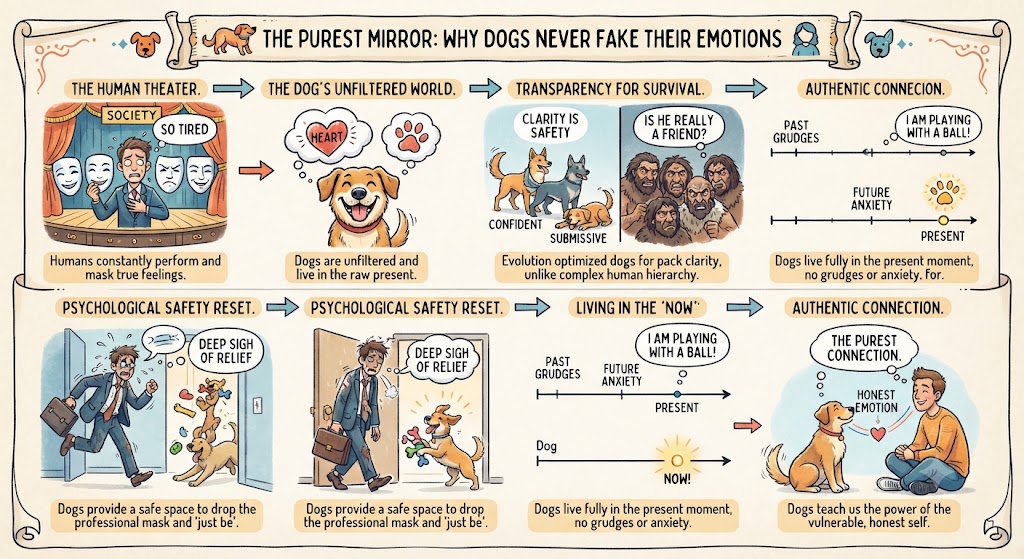
Human interaction is a complex architecture of performance. We possess the unique, often burdensome, capacity to mask our true feelings. We offer polite smiles when we are annoyed, nod in agreement when we fundamentally disagree, and project confidence when we are trembling with anxiety. This ability to “fake” emotion is a cornerstone of human social cohesion—a necessary lubricant for navigating the delicate nuances of societal expectations, career advancement, and interpersonal conflict. Yet, in this sophisticated theater of masks, we often find ourselves exhausted by the cognitive labor of maintaining our personas.
This is precisely why the presence of a dog is so profoundly healing. Dogs are the antithesis of this human performance. They are the purest mirror we have, reflecting a version of reality that is unfiltered, immediate, and utterly sincere. A dog does not know how to lie; they have never mastered the art of the social veneer because they have no use for it. Their emotional landscape is not a curated display for an audience; it is an raw, honest experience of the present moment.
To understand why dogs never fake their emotions, we must look at the biological and social imperatives that drive their existence. Unlike humans, whose survival has historically depended on navigating intricate hierarchical power structures and complex linguistic nuances, a dog’s survival—and their social success—has always depended on clarity. Within a pack, ambiguity is dangerous. If a dog is aggressive, the pack needs to know immediately. If a dog is submissive, the pack needs to know immediately. The stakes of misinterpretation are simply too high. Consequently, evolution has optimized the dog’s emotional expression for total transparency. A snarl is not a rhetorical device; it is a clear boundary. A tail wag is not a polite gesture; it is an authentic broadcast of engagement.
This transparency creates a profound sense of psychological safety for the human owner. When we walk through the door after a long day of “performing” our professional selves, our dog provides a radical reset. They do not care about the status we project or the professional persona we wear. They care only about the state of our connection. If we are sad, they do not offer platitudes; they offer proximity. If we are joyful, they do not temper their excitement with professional stoicism; they match our frequency perfectly. Because we know that a dog’s love, excitement, and even their moments of stubbornness are genuine, we are finally allowed to drop our own masks. We don’t have to “perform” for them. We are simply allowed to be.
Furthermore, the “honesty” of a dog is rooted in their total immersion in the present. Humans are creatures of narrative—we ruminate on the past and catastrophize about the future. We fake emotions often to protect ourselves from future consequences or to sanitize past mistakes. Dogs, however, live almost entirely in the “now.” If a dog is frustrated because their favorite toy is stuck under the couch, their emotion is acute and immediate. But the moment that frustration is resolved, it vanishes. They do not hold onto “grudges” or “passive-aggressive” sentiments because they lack the complex, long-term cognitive narrative required to construct such things. They feel, they react, and they return to equilibrium. This cycle is a masterclass in emotional health that humans rarely achieve.
There is also a profound dignity in this authenticity. In a world where we are constantly incentivized to build personal brands and curate our online and offline images, the dog stands as a quiet reminder of the power of the “true self.” They are unapologetically themselves at all times. When they are tired, they sleep. When they are hungry, they let you know. When they are happy, they are incandescent. There is no shame in their needs and no deceit in their expressions. By observing them, we are subtly invited to reconsider our own relationship with authenticity. We are challenged to ask: What would happen if I were as honest about my own state as my dog is about theirs?
Ultimately, the reason dogs never fake their emotions is that their loyalty is not to a social code, but to the truth of their own internal experience. They are incapable of betrayal because betrayal requires the cognitive ability to know one thing and express another. They are incapable of gaslighting because they cannot manipulate the emotional reality of a situation. They are simply, beautifully, themselves. In the quiet, honest exchange of a gaze with a dog, we are reminded that beneath all our complicated human social engineering, the most powerful and nourishing thing we can offer one another—and ourselves—is the simple, terrifying, and wonderful truth of how we feel. Dogs never fake their emotions because they understand something we have long forgotten: the most profound connection is not found in the perfect performance, but in the vulnerable, unfiltered, and honest expression of who we really are.

